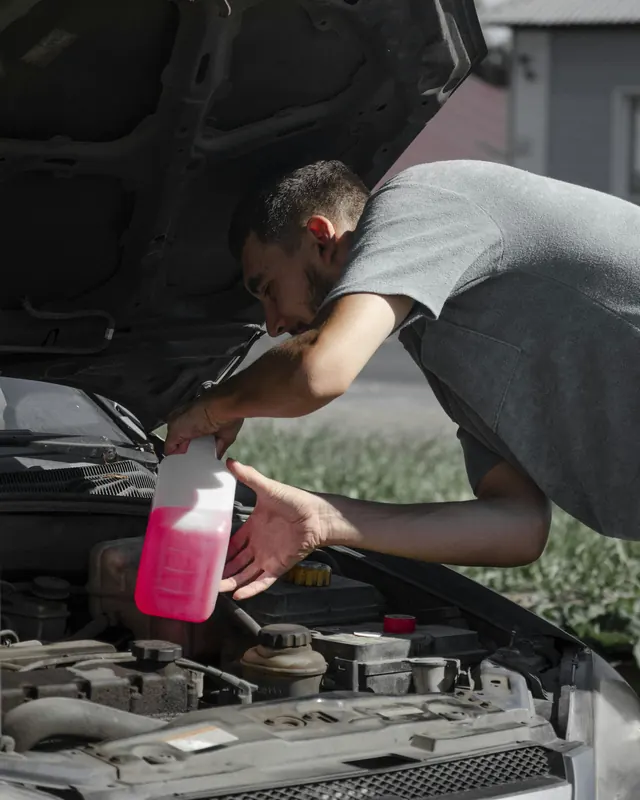
How Often Should You Flush Coolant? Intervals by Coolant Type
Photo: Denis Sorokin on Unsplash
On this page
- The short answer
- How often should you change engine coolant?
- What's the difference between green, orange and other coolants?
- Can you mix different types or colors of coolant?
- What's the difference between a coolant flush and a drain-and-fill?
- How can you tell if your coolant needs changing?
- Can I check or top off coolant myself?
- When to bring it in
- Recent work like this
- Common questions
The short answer
Change engine coolant on the schedule in your owner's manual. Older green coolant is usually due every two years or about 24,000 to 30,000 miles, while long-life coolants typically last five years or longer, and some automakers list 100,000 miles or more. Coolant can also wear out early, so have it tested on higher-mileage cars.
Your maintenance reminder says the coolant is due, or a service writer mentioned a flush, and you want to know if it's really needed yet. The honest answer depends on which coolant your car uses, because intervals range from two years to more than ten. Here's how to find your number, what the different coolants are, and how to tell if yours is worn out early.
How often should you change engine coolant?
Change engine coolant at the interval in your owner's manual, which depends mostly on the type of coolant your car came with. As a general rule, AAA says coolant should be changed every 30,000 miles or two years, whichever comes first, but long-life coolants in newer cars last much longer.
Toyota puts it this way: silicate-based coolant is usually changed every two years or 30,000 miles, while extended drain coolants can last up to five years or 100,000 miles.
Automakers don't agree with each other, either. Cars.com found that most Hyundai models call for new coolant after the first 60,000 miles and every 30,000 miles after that, that some Mercedes-Benz models list 120,000 miles or 12 years and others 150,000 miles or 15 years, and that many Chevrolets call for a change at 150,000 miles.
So a mileage you've heard secondhand may not match your car. If you don't have the manual, the schedule is usually on the automaker's owner website, or we can look it up.
What's the difference between green, orange and other coolants?
Coolants are grouped by the chemistry that protects the engine from corrosion, and that chemistry sets how long they last. AAA lists three main types:
| Coolant type | Common colors (AAA) | Typical change interval (AAA) |
|---|---|---|
| IAT (older "conventional") | Green | Every 2 years or 24,000 miles |
| OAT (organic acid) | Orange, yellow, red or purple | Every 5 years or 50,000 miles |
| HOAT (hybrid organic acid) | Mostly orange and yellow | Every 5 years or 50,000 miles; some automakers list up to 10 years or 150,000 miles |
AAA says green IAT coolant is rarely used as the factory fill anymore. OAT is common in General Motors vehicles and some others, and HOAT is common in Chrysler and Ford vehicles.
Treat the table as a starting point. The interval printed in your manual for your engine is the one that counts.
Can you mix different types or colors of coolant?
No. Don't mix coolant types, and don't pick coolant by color. AAA says OAT coolants are not compatible with other types, and that coolants are often orange or yellow, so they're easy to misidentify by color alone. Two orange coolants can be completely different chemistry.
AAA also points out that a previous owner or shop may have changed the coolant type at some point. If you want to switch back to the factory coolant, AAA says a complete cooling system flush is needed first.
A few habits that keep you out of trouble:
- Read the cap or the manual. Many reservoir caps name the coolant type.
- Buy the type your manual lists. Even with a "universal" bottle, check that it meets the spec in your manual.
- Watch the premix. Kelley Blue Book warns that adding water to a 50/50 premixed coolant dilutes it.
What's the difference between a coolant flush and a drain-and-fill?
A drain-and-fill opens the drain and replaces what comes out. A flush goes further. Kelley Blue Book describes a flush as draining and replacing the antifreeze while removing rust, sediment and scale that can cause overheating.
Opening the radiator drain usually doesn't empty the whole system, because coolant also sits in the engine block, the heater core and the hoses. Cars.com notes that some manufacturers recommend draining and flushing more often under severe service, such as frequent towing, and that a flush may also be needed to remove contaminants. When you're switching coolant types or the old coolant is dirty, a flush is the right call. When the coolant tests fine and the car is simply due, the procedure in your service manual decides which one fits.
How can you tell if your coolant needs changing?
You test it. Coolant can look fine and still be worn out. Cars.com explains that it becomes more acidic over time and loses its rust-inhibiting properties, and that a cooling system can be checked with test strips that measure acidity and a hydrometer that measures freezing and boiling protection. The same article says coolant in any vehicle with more than about 50,000 miles should be tested periodically.
Some signs mean the cooling system needs attention now, not at the next interval. From Kelley Blue Book and Toyota:
- A sweet, syrup-like smell from under the hood
- Coolant with visible debris floating in it
- A gurgling sound when you start the car
- The temperature gauge climbing toward the red, or the engine overheating with the reservoir full
- A puddle under the front of the car
A sweet smell or a puddle usually points to a leak, not old coolant. Our guide to coolant leak signs covers where they come from, and if the gauge is in the red, read what to do when your car overheats before driving any farther.
Can I check or top off coolant myself?
Yes, checking the level is a good driveway job. Do it with the engine cold. Kelley Blue Book warns never to take the radiator cap off unless the engine is completely cool, or hot coolant will erupt under pressure.
- Park on level ground and let the engine cool fully. A few hours, or check first thing in the morning.
- Look at the plastic reservoir. Kelley Blue Book says most have two fill lines, and the lower one is for a cold engine. Keep the level at the line.
- Top off with the correct coolant if it's a little low.
- Look at the hoses while you're there. Kelley Blue Book says to replace hoses that are soft, worn or over five years old.
Coolant is toxic to people and pets, and Kelley Blue Book notes that even a small amount swallowed can cause illness. Wipe up spills and keep jugs sealed and out of reach. If you keep having to top it off, something is leaking, and adding more just hides it.
Around here, the cooling system works hardest on summer days over 100°F, in stop-and-go traffic on I-15 and on long climbs like the Ortega Highway grade. That's when a weak coolant mix or a tired hose usually gives up.
When to bring it in
Bring it in when your maintenance schedule says the coolant is due, when the car passes about 50,000 miles and the coolant has never been tested, or right away if you see the temperature gauge climbing, smell coolant or find a puddle.
Here's what we do, in order:
- Look up your engine's coolant type and change interval, and ask what you've noticed.
- Check the coolant level, condition and protection, and look at the radiator, hoses, cap and water pump for leaks.
- If the car is running hot, check the thermostat and fans too. Our thermostat guide explains what we look for.
- Give you a written estimate before any work, and tell you what's due now and what can wait. Our repairs carry a 1-year/12,000-mile warranty.
You can read more about our engine and cooling system services, or call us at (951) 445-8055.
Recent work like this at our shop
A few recent jobs from our service records. Vehicle, mileage and month only; no customer details.
| Vehicle | Work | Mileage | When |
|---|---|---|---|
| 2005 Honda Accord | Radiator, Cooling system flush | 134,388 mi | Jul 2026 |
| 2006 Toyota Tundra | Cooling system flush | 132,488 mi | Jul 2026 |
| 2020 Ram 1500 | Thermostat, Water pump | 108,493 mi | Jul 2026 |
| 2020 Cadillac XT6 | Thermostat | 47,722 mi | Jul 2026 |
| 2014 Infiniti Q50 | Radiator, Thermostat, Cooling system flush | 140,443 mi | Jun 2026 |
Common questions
How often should coolant be flushed?
Follow the interval in your owner's manual, because it ranges widely. AAA says older green coolant is usually changed every two years or 24,000 miles, while long-life OAT and HOAT coolants are typically changed every five years or 50,000 miles, and for HOAT some automakers list as long as 10 years or 150,000 miles.
Can I mix two different colors of coolant?
Don't mix types. AAA says OAT coolants aren't compatible with other types, and that color alone isn't a reliable way to tell coolants apart. Top off with the exact type your owner's manual lists, and if you're not sure what's in the car now, have it checked before adding anything.
Is a coolant flush really necessary?
Coolant does wear out. Cars.com explains that it becomes more acidic over time and loses its rust inhibitors, which lets corrosion attack the radiator, water pump, thermostat and hoses. Changing it on schedule is far easier than replacing those parts.
Can I just add water instead of coolant?
Only to get off the road in an emergency. Toyota says water alone isn't recommended because it can boil, freeze and cause rust. Toyota notes that coolant is usually a 50/50 mix of antifreeze and water, and Kelley Blue Book warns that adding water to premixed coolant dilutes it.
How do I know what coolant my car takes?
Check the owner's manual or the cap on the coolant reservoir, which often names the type. Don't go by the color in the tank, since AAA notes that different coolant types are often the same orange or yellow color.
Sources
More from the blog
When to Replace Spark Plugs: Mileage by Plug Type and the Signs They're Worn
How many miles copper, platinum and iridium spark plugs usually last, the signs of worn plugs, why the whole set gets replaced together and when to get them checked.
Car Heater Blowing Cold Air? The Usual Causes and What to Check
Heat set to hot but the vents blow cold? The usual causes, from low coolant to a stuck blend door, what you can check yourself and when it means a bigger problem.
What Is a Tune-Up? What's Included on a Modern Car and When You Need One
What a tune-up really includes on a modern car, which parts still wear out, the signs to watch for and when a rough-running engine needs a diagnosis instead.