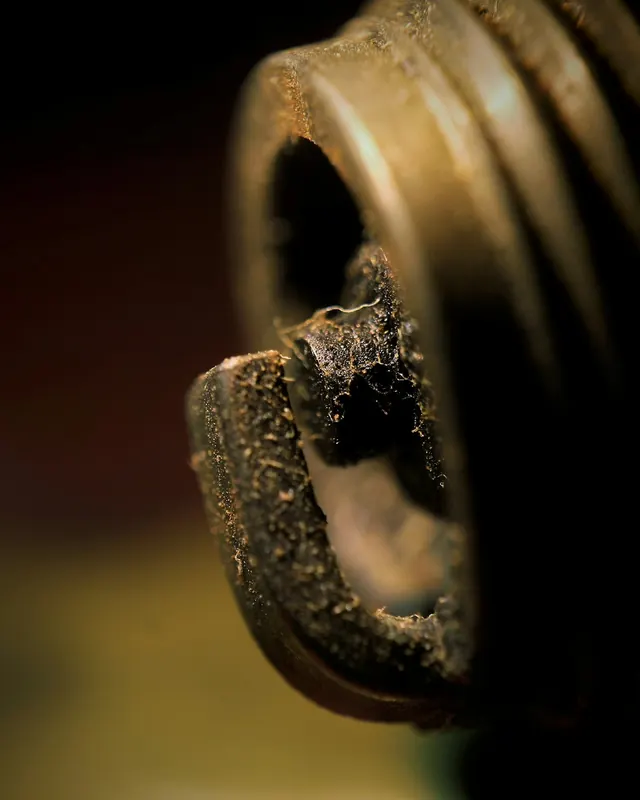
When to Replace Spark Plugs: Mileage by Plug Type and the Signs They're Worn
Photo: Tonmoy Iftekhar on Unsplash
On this page
- The short answer
- How often should spark plugs be replaced?
- How long do copper, platinum and iridium plugs last?
- What are the signs of bad spark plugs?
- Is it safe to drive with worn spark plugs?
- Why does replacing spark plugs take more work on newer cars?
- Can I change spark plugs myself?
- When to bring it in
- Recent work like this
- Common questions
The short answer
Replace spark plugs at the mileage in your owner's manual. AAA says most manufacturers call for new plugs somewhere between 30,000 and 100,000 miles, with copper plugs wearing out first and platinum and iridium plugs lasting the longest. Replace them sooner if the engine misfires, idles rough, starts hard or loses fuel economy.
Your car is creeping up on 60,000 or 100,000 miles and spark plugs are on the maintenance list, or the engine has started to stumble at idle and you're wondering if the plugs are the reason. Here's how long each type of plug usually lasts, the signs they're worn, and what replacing them involves on a modern engine.
How often should spark plugs be replaced?
Spark plugs should be replaced at the mileage listed in your owner's maintenance schedule. That number depends on the engine and the type of plug it came with. AAA says most manufacturers recommend new plugs every 30,000 to 100,000 miles, and that plug type, engine design and engine condition can call for replacement sooner.
Cars.com says some manufacturers call for new plugs as soon as 60,000 miles, while others say 100,000 miles or later. If you can't find your manual, the schedule is usually on the automaker's owner website, or we can look it up for you.
How long do copper, platinum and iridium plugs last?
The plug's electrode material sets most of its life. Harder metals wear away more slowly under the spark, so they hold their gap longer. Here's what AAA and NGK, one of the big plug makers, say about each type:
| Plug type | How long it usually lasts | Notes |
|---|---|---|
| Copper (nickel tip) | Roughly 20,000 miles (AAA) | Most common type, but wears the fastest |
| Platinum | Up to 100,000 miles (AAA) | Higher melting point, handles heat well |
| Iridium | AAA calls them the longest lasting | NGK says iridium is six times harder than platinum |
NGK also notes that standard nickel plugs need replacing earlier than precious metal plugs, and that the manufacturer's interval is still the one to follow.
Upgrading isn't a way to skip the schedule. The Car Care Council recommends replacing all of the plugs at once with the same type the car came with. If your engine left the factory with iridium plugs, a set of copper plugs would put you back on a much shorter interval.
What are the signs of bad spark plugs?
Worn spark plugs usually show up as a rough-running engine before anything else. The common signs, from AAA, NGK, the Car Care Council and Brake & Front End:
- Rough idle. A shake or vibration at a stoplight, sometimes enough to stall.
- Misfires. A stumble or jerk, often easiest to feel under load, like climbing the Ortega Highway grade or merging onto I-15.
- Hesitation or sluggish acceleration. The car is slow to respond when you press the pedal.
- Hard starting. It cranks longer than usual before it catches.
- Lower fuel economy. AAA notes that misfiring plugs waste fuel.
- A check engine light, steady or flashing.
None of these prove it's the plugs. Ignition coils, fuel injectors and vacuum leaks cause the same symptoms. A code read and a look at which cylinder is misfiring narrows it down fast, which is why we'd test before swapping parts. Our tune-up guide explains why "replace everything and hope" isn't a good first step.
Is it safe to drive with worn spark plugs?
A car with worn plugs that still runs smoothly is safe to drive to a shop. A misfiring engine is a different story. When a cylinder misfires, unburned fuel goes into the exhaust. Brake & Front End, a repair trade magazine, warns that plug misfires can ruin catalytic converters.
Watch the check engine light. A steady light with a car that drives normally can wait for an appointment soon. A flashing light usually means an active misfire: ease off, avoid hard acceleration and have it checked right away. If the engine is shaking badly, losing power or smoking, pull over when it's safe and shut it off. Our check engine light guide covers steady vs flashing in more detail.
Why does replacing spark plugs take more work on newer cars?
Many modern engines bury the plugs under other parts. Brake & Front End notes that today's long-life plugs often require more extensive disassembly to reach, and AAA says some cars need components removed before a technician can get to the plugs.
Most newer engines also use coil-on-plug ignition, with one coil sitting right on top of each plug instead of plug wires. Each coil comes off to reach its plug, which is a good time to check the coil boots for cracks or carbon tracks. A boot with a carbon track should be replaced along with the plug, according to the same article.
Long intervals bring one more problem: plugs that have sat in an aluminum cylinder head for 100,000 miles can stick. Steel plug threads can seize to aluminum, according to Brake & Front End. The article recommends letting an aluminum-head engine cool first and says many manufacturers call for soaking the threads with penetrating oil before removing the plugs. Damaged threads can sometimes be repaired in the car, but a bad case can mean taking the cylinder head off.
Can I change spark plugs myself?
On some engines, yes, if the plugs are easy to reach and you have the right tools. Before you start:
- Work on a cold engine. AAA says the engine must be cold to change plugs.
- Buy the plug your manual lists. The trade article says the safest choice is an OE-approved brand and part number.
- Don't regap fine-wire plugs. DENSO, another plug maker, advises against changing the gap on platinum or iridium plugs because the fine electrodes can be damaged.
- Use a torque wrench. Brake & Front End says modern plugs are generally torqued between 8 and 17 foot-pounds. Too tight can damage aluminum threads, and too loose can let the plug overheat.
If the plugs are under the intake, or one won't turn with normal effort, stop there. Forcing a stuck plug is how a routine job turns into a cylinder head repair.
When to bring it in
Bring it in when your maintenance schedule says the plugs are due, or sooner if the engine misfires, idles rough, starts hard, hesitates or has a check engine light on. Bring your maintenance records if you have them, since knowing when the plugs were last changed helps.
Here's what we do, in order:
- Look up your engine's plug type and interval, and ask what you've noticed.
- Scan for codes and check which cylinder, if any, is misfiring.
- Pull and inspect the plugs and coil boots, and check the coils if a misfire points to one.
- Give you a written estimate before any work, and tell you what's due now and what can wait. Our repairs carry a 1-year/12,000-mile warranty.
You can read more about our engine services or book a diagnostic if the engine is running rough.
Recent work like this at our shop
A few recent jobs from our service records. Vehicle, mileage and month only; no customer details.
| Vehicle | Work | Mileage | When |
|---|---|---|---|
| 2021 Nissan Sentra | Spark plugs | 96,298 mi | Mar 2026 |
| 2012 Toyota Sienna | Spark plugs | 121,087 mi | Nov 2025 |
| 2023 Ford Edge | Spark plugs | 75,094 mi | Sep 2025 |
| 2009 BMW 328i | Spark plugs | 101,738 mi | Jun 2025 |
| 2005 Toyota Camry | Spark plugs | 203,262 mi | May 2025 |
Common questions
How many miles do spark plugs last?
It depends on the plug and the engine. AAA says most manufacturers recommend changing them every 30,000 to 100,000 miles, that copper plugs last roughly 20,000 miles and that platinum plugs can last up to 100,000 miles. Your owner's manual has the number for your car.
Do iridium spark plugs really last 100,000 miles?
Often, if that's what your owner's manual lists. AAA calls iridium the longest lasting plug type, and Cars.com says some manufacturers call for new plugs at 100,000 miles or later. AAA also notes that engine design and condition can call for replacement sooner.
Should I replace all the spark plugs at once?
Yes. The Car Care Council recommends replacing all of the plugs at the same time, with the same type the car came with from the factory. That keeps every cylinder on the same plug and the same replacement interval.
Can bad spark plugs cause a check engine light?
Yes. A worn plug can misfire, and the engine computer records misfires as codes such as P0300. A flashing check engine light usually means an active misfire, so ease off and have it checked right away.
Do spark plugs need to be replaced if the car runs fine?
Yes, once they reach the interval in the owner's manual. Plugs wear slowly, so the change is easy to miss until misfires start. The interval is there so you replace them before that point.
Sources
- AAA, What Do Spark Plugs Do?
- Car Care Council, Spark Plugs Need to Be Replaced Periodically
- Cars.com, How Often Should I Replace My Spark Plugs?
- Brake & Front End, Spark Plug Replacement Is a Big Deal in Today's Market
- DENSO, Spark Plugs, Frequently Asked Questions
- NGK Spark Plugs, You Asked Google and NGK Answers, Part 1
More from the blog

Car Heater Blowing Cold Air? The Usual Causes and What to Check
Heat set to hot but the vents blow cold? The usual causes, from low coolant to a stuck blend door, what you can check yourself and when it means a bigger problem.
What Is a Tune-Up? What's Included on a Modern Car and When You Need One
What a tune-up really includes on a modern car, which parts still wear out, the signs to watch for and when a rough-running engine needs a diagnosis instead.
Timing Belt vs Timing Chain: Which One You Have and When It Needs Replacing
Timing belt or timing chain? How to tell which your car has, when each one needs replacing, what an interference engine is and what a startup rattle can mean.