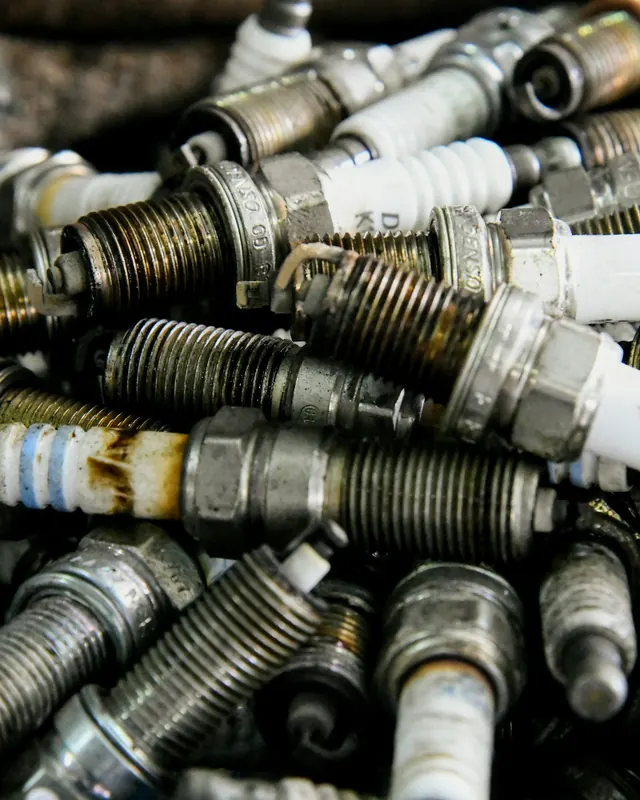
What Is a Tune-Up? What's Included on a Modern Car and When You Need One
Photo: shraga kopstein on Unsplash
On this page
- The short answer
- What is included in a tune-up today?
- Do modern cars still need tune-ups?
- What are the signs your car needs a tune-up?
- How often should spark plugs be replaced?
- Is fuel injector cleaning part of a tune-up?
- When do you need a diagnosis instead of a tune-up?
- When to bring it in
- Recent work like this
- Common questions
The short answer
On a modern car, a tune-up isn't one set job anymore. It usually means a scheduled maintenance visit or an inspection and replacement of wear items such as spark plugs and filters. If the engine is running badly, skip the word and describe the symptom, because that calls for a diagnosis, not a list of parts.
Maybe someone told you the car is due for a tune-up, or it's running a little rough and that's the word that came to mind. Fifty years ago it meant a specific job. Today it doesn't, so here's what it means now, what's worth doing, and when a rough-running car needs a diagnosis instead.
What is included in a tune-up today?
There's no single list anymore. Kelley Blue Book says the word now usually means one of two things: a scheduled maintenance visit based on your owner's manual or the car's maintenance reminder, or an inspection and replacement of wear items like filters, fluids, belts, hoses and tires.
So two shops can use the same word for different work. KBB's description of a typical one is an oil change, a tire rotation and an inspection of parts such as spark plugs, belts and hoses.
Here's how the job has changed, based on Cars.com's breakdown and KBB:
| Item | Older cars | Most cars today |
|---|---|---|
| Spark plugs | Then: often replaced about once a year | Now: often last 100,000 miles or more, with their own line on the schedule |
| Points and condenser | Then: often replaced about once a year | Now: not on the car |
| Distributor cap, rotor, plug wires | Then: sometimes added to the job | Now: many cars don't have these |
| Ignition timing | Then: adjusted as part of the service | Now: no longer a routine adjustment |
| Computers and sensors | Then: far fewer of them | Now: usually replaced only when they fail |
Do modern cars still need tune-ups?
Not the old kind, but they still need maintenance. Electronic ignition, long-life plugs and onboard diagnostics took away most of the regular adjusting and replacing.
What's left is the maintenance schedule in your manual. It lists plugs, filters and fluids separately, each with its own interval, and that's a better guide than a single word. Cars.com goes further, saying that asking for a tune-up isn't really a useful request anymore and is unlikely to fix a running problem.
We still list engine tune-ups at our shop, since people still use the word. We just want to know what you're after: routine maintenance that's due, or a problem you've noticed. The two lead to different work.
What are the signs your car needs a tune-up?
These are signs that something needs attention, not proof you need a particular service. The common ones, from Cars.com and KBB:
- Misfires or a rough idle. You may feel a shake at a stoplight, or when you're climbing a grade like Ortega Highway.
- Hard starting or stalling. If it stalls in traffic or keeps stalling, don't keep driving it. Have it towed.
- Hesitation or sluggish acceleration.
- Worse gas mileage. Expect some drop in cold months, so look for a change that doesn't fit the season.
- Knocking or pinging. Light pinging can wait for a visit soon. A loud, deep knock from the engine means pull over and shut it off.
- A check engine light, steady or flashing.
- A failed emissions test.
The trouble is that one symptom can have several causes. Worse mileage might be worn plugs or a faulty oxygen sensor. Weak acceleration might be plugs or a clogged engine air filter, which is worth a look at regular service anyway. That's why replacing a set of parts and hoping isn't a good first step.
How often should spark plugs be replaced?
Follow the interval in your owner's manual, since it depends on the engine and the type of plug. Cars.com says most plugs should last 100,000 miles or more. KBB notes that copper plugs typically wear out sooner, while platinum and iridium plugs often last much longer. An older car may call for a shorter interval.
Worn plugs can cause misfires, hard starting, sluggish acceleration and lower fuel economy. Cars.com says engine computers do a remarkable job of compensating for worn plugs, so you may not feel the wear. If your car is near its plug mileage, go by the schedule, even if it seems fine.
Is fuel injector cleaning part of a tune-up?
It can be on the list, but it usually isn't routine maintenance if you buy good-quality gas. That's about fuel quality, not premium octane. Cars.com says that with a good grade of gasoline, you likely won't need the injectors cleaned on a schedule, and that some manufacturers recommend Top Tier gas. Deposits from low-quality or contaminated gas can cause drivability problems, and then the fix might be a fuel system cleaning at a shop or a gas-tank additive, which works more slowly.
We do fuel injection cleaning, and we'd suggest it when the symptoms and test results point that way. Throttle body cleaning is similar: Cars.com says it's usually only needed if there's a running problem.
When do you need a diagnosis instead of a tune-up?
Any time the car is doing something wrong, or the check engine light is on. KBB says modern tune-ups often involve reading codes and live data instead of replacing parts on a hunch. Cars.com's advice is to tell the mechanic what you're experiencing and ask them to find the cause.
It helps to note when it happens: cold or warm, at idle or on the freeway, going uphill or on flat ground. Details like that narrow the search.
A steady check engine light is worth getting read soon. A flashing one usually means an active misfire, which can damage the catalytic converter, so ease off, avoid hard acceleration and get it checked right away. If the engine is shaking badly, losing power, smoking or giving off a strange smell, pull over when it's safe, shut it off and don't keep driving it. A red oil or temperature light also means pull over and shut it off, as our dashboard warning lights guide explains.
One more case for testing over guessing: Cars.com notes that an old oxygen sensor, around 90,000 miles or more, may still work well enough not to set the light but could still hurt fuel economy.
When to bring it in
Bring it in if the engine is running rough, starting hard, losing power or using more gas than it used to, or if your schedule shows plugs or filters are due and you'd like them handled together. Bring your maintenance records if you have them.
Here's what we do, in order:
- Ask what you've noticed and look up what's due at your mileage.
- Scan for codes and test the system involved if there's a symptom or a light.
- Inspect the plugs, filters, belts and hoses that apply to your car.
- Give you a written estimate for the repair, and tell you what can wait and what can't. No repair work starts until you've approved it. Our repairs carry a 1-year/12,000-mile warranty.
You can read more about our engine services or book a diagnostic.
Recent work like this at our shop
A few recent jobs from our service records. Vehicle, mileage and month only; no customer details.
| Vehicle | Work | Mileage | When |
|---|---|---|---|
| 2021 Nissan Sentra | Spark plugs, Fuel injection cleaning | 96,298 mi | Mar 2026 |
| 2012 Toyota Sienna | Spark plugs | 121,087 mi | Nov 2025 |
| 2023 Ford Edge | Spark plugs | 75,094 mi | Sep 2025 |
| 2009 BMW 328i | Spark plugs | 101,738 mi | Jun 2025 |
| 2005 Toyota Camry | Spark plugs | 203,262 mi | May 2025 |
Common questions
What is included in a tune-up?
There's no standard list today. Kelley Blue Book says a typical one includes an oil change, a tire rotation and an inspection of parts like spark plugs, belts and hoses. Ask for the list of what's included before you agree to one, and compare it to your owner's manual.
How often does a car need a tune-up?
Most modern cars don't have a tune-up interval. They have a maintenance schedule in the owner's manual, with separate lines for items like spark plugs and filters. Go by that schedule, and have the car checked sooner if it starts running poorly.
Will a tune-up improve my gas mileage?
Only if something was actually hurting it. Worn spark plugs and a faulty oxygen sensor can both lower fuel economy, so fixing them can help. New parts on a car that was running fine aren't likely to change much, and mileage also tends to dip in cold weather.
Is a tune-up the same as an oil change?
No, though some shops count an oil change as part of one. An oil change is a single service with its own interval. A tune-up, when a shop uses the word, usually means a wider look at maintenance items.
Sources
More from the blog
Timing Belt vs Timing Chain: Which One You Have and When It Needs Replacing
Timing belt or timing chain? How to tell which your car has, when each one needs replacing, what an interference engine is and what a startup rattle can mean.
Coolant Leak Signs: Puddle Colors, Sweet Smells and What to Do
A colored puddle, a sweet smell or a reservoir that keeps dropping? How to spot a coolant leak, where it usually comes from and when it's not safe to drive.
Bad Thermostat Symptoms: Stuck Open vs Stuck Closed
Gauge stuck on cold, weak heat, or an engine that runs hot fast? How to tell a thermostat stuck open from one stuck closed, what P0128 means and when to fix it.