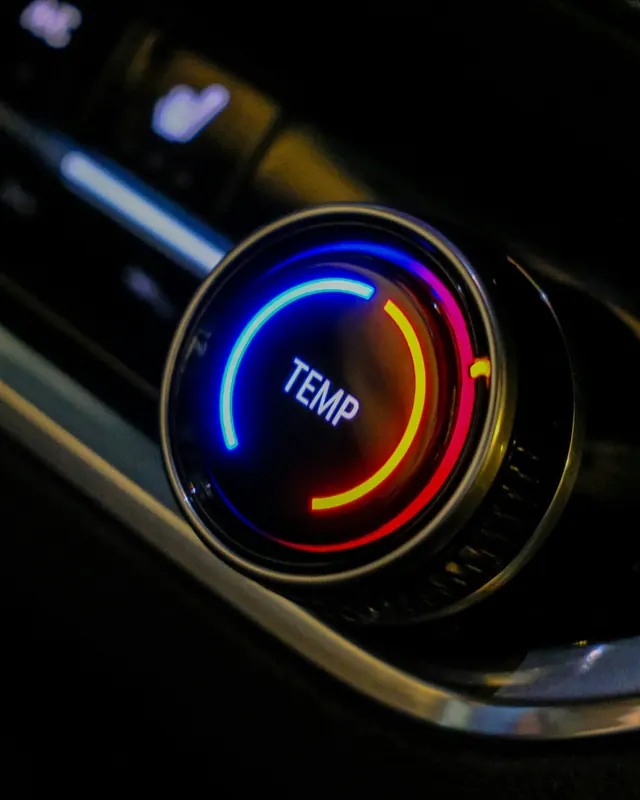
Car Heater Blowing Cold Air? The Usual Causes and What to Check
Photo: Hansheng Zhao on Unsplash
On this page
The short answer
Your car's heater runs on hot engine coolant, so cold air from the vents usually means hot coolant isn't reaching the heater core or air isn't being sent across it. The common causes are low coolant, a thermostat stuck open, a clogged heater core and a stuck blend door. Low coolant is the one to rule out first, because it can also lead to overheating.
The first cold morning of the season, you turn the dial to hot and get a blast of cold air that never warms up. Or the heat comes up weaker than last winter. Either way, it's worth figuring out, because the heater is tied to the engine's cooling system. Here's how the heat works, what usually stops it, and what you can check before you call a shop.
How does a car heater make heat?
It borrows heat from the engine. The cooling system pumps coolant through the engine, where it picks up heat, and on to the radiator. Cars.com explains that some of that hot coolant also goes to the heater core, a small radiator behind the dashboard. A fan blows air through the warm core and into the cabin.
That's why the heat takes a few minutes to come up on a cold start: the engine has to warm up first. It's also why a heater problem is often a cooling system problem.
Cars.com says cold air from the vents usually comes down to one of two things: hot coolant isn't reaching the heater core, or air isn't being blown across it.
Why is my car heater blowing cold air?
These are the usual causes, drawn from Cars.com and AutoZone:
- Low coolant. Without enough coolant, not enough reaches the heater core. Low coolant almost always means a leak somewhere.
- A thermostat stuck open. The engine never reaches its normal temperature, so the coolant isn't hot enough to warm the cabin.
- A clogged heater core. AutoZone says debris, rust or sediment from old coolant can block the small passages in the core.
- A stuck blend door. This door behind the dashboard mixes air across the heater core to set the temperature. If it sticks, AutoZone says you may get only cold air no matter how high you set the dial.
- A heater control valve that won't open, on cars that have one. Cars.com says this valve in the heater hose is a more likely problem than a plugged core when the hoses aren't both warm.
- Air trapped in the cooling system, often after coolant work, which can block flow to the core. AutoZone says to bleed it the way the manufacturer recommends.
- Climate control electronics. On cars with automatic climate control, Cars.com notes the computer that runs the heater can fail.
When the heater hoses aren't both warm, Cars.com also lists a broken serpentine belt and a failing water pump. Both usually show up as overheating too. AutoZone also lists a leaking head gasket, which it calls one of the most serious issues.
What does the temperature gauge tell you?
Quite a bit. Start the car, drive until it would normally be warm, and look at the gauge.
| What you see | What it usually points to |
|---|---|
| Gauge sits near cold, heat is weak or cold | Engine isn't warming up: most often a thermostat stuck open |
| Gauge normal, heat cold | Coolant isn't reaching the core, or a blend door or control problem |
| Gauge high or climbing, heat cold | Engine overheating, often from low coolant: pull over, shut it off and have it checked |
Cars.com says a gauge stuck near cold, or one reading too hot, can both leave you without heat. If your car has no gauge, check that no temperature warning light is on after several minutes of running.
A gauge that stays low points toward the thermostat. Our post on bad thermostat symptoms covers how to tell stuck open from stuck closed, and what code P0128 means.
What can I check myself?
A few things are safe to check in the driveway:
- The controls. Make sure the dial is on hot, air is coming out of the vents and the fan is on. It sounds obvious, but it's the first thing Cars.com lists.
- The coolant level. With the engine cold, look at the overflow reservoir and see if the level is between the marks. Never open the radiator cap on a warm engine: Cars.com says the radiator should be cool to the touch first.
- Leaks. Look under the car for drips or a puddle after it's been parked. Our post on coolant leak signs shows what coolant looks like and where it tends to leak.
- The heater hoses, if you're comfortable under the hood. Cars.com describes two hoses about an inch across going into the firewall, usually on the passenger side or toward the middle. With the engine warm, carefully feel them. If both are very warm and about the same, hot coolant is reaching the core and the problem is likely the blend door or controls. If one is hot and the other cool, hot coolant isn't getting through the core. AutoZone says the core may be clogged, and Cars.com says a heater control valve that isn't opening is the more likely cause on cars that have one. Watch for hot parts and the cooling fan, which can come on by itself.
Past that, most of the work needs tools. The blend door and heater core sit behind the dashboard, and AutoZone notes that replacing a heater core often means removing the dash.
Is it a bigger problem than no heat?
Sometimes. AutoZone says cold air from the vents usually means a mechanical problem that needs to be fixed, not just a setting. Low coolant is the main reason: the same leak that leaves the heater cold can leave the engine without enough coolant to stay cool. Our post on what to do when your car is overheating covers that situation step by step.
Watch for these along with cold heat:
- The temperature gauge climbing toward hot, or a temperature warning light. Pull over when it's safe and shut the engine off.
- Coolant that keeps dropping with no puddle under the car.
- A sweet smell inside the car, a greasy film on the inside of the windshield or a damp passenger floor mat, which can point to a leaking heater core.
- White smoke from the tailpipe that doesn't clear once the engine is warm.
There's also the windshield. Weak heat means a slow defroster, and on a cold, damp morning heading out on I-15 or Railroad Canyon Road, a fogged windshield is a safety problem. Turn on the defroster with the A/C on, which dries the air even when the heat is weak, and don't drive until the glass is clear.
When to bring it in
Bring it in if the heat stays cold after you've checked the controls and the coolant level, if the coolant keeps going down, or if the gauge isn't where it normally sits. Note when it happens: right after a cold start, at idle, or on the freeway. That helps narrow it down.
Here's what we do, in order:
- Ask what you've noticed and check the coolant level and condition.
- Check engine temperature and look for codes such as P0128 with a scan tool.
- Test the cooling system for leaks and check the thermostat, hoses and water pump.
- Check whether hot coolant is reaching the heater core, then look at the controls and blend door.
- Give you a written estimate, and tell you what can wait and what can't. No work starts until you approve it, and our repairs carry a 1-year/12,000-mile warranty.
You can read more about our engine and cooling system services or book a diagnostic.
Recent work like this at our shop
A few recent jobs from our service records. Vehicle, mileage and month only; no customer details.
| Vehicle | Work | Mileage | When |
|---|---|---|---|
| 2005 Honda Accord | Cooling system flush | 134,388 mi | Jul 2026 |
| 2006 Toyota Tundra | Cooling system flush | 132,488 mi | Jul 2026 |
| 2020 Ram 1500 | Thermostat, Water pump | 108,493 mi | Jul 2026 |
| 2020 Cadillac XT6 | Thermostat | 47,722 mi | Jul 2026 |
| 2014 Infiniti Q50 | Thermostat, Cooling system flush | 140,443 mi | Jun 2026 |
Common questions
Why is my car heater blowing cold air but the engine is hot?
If the engine is at normal temperature, hot coolant is there, so the problem is getting it into the heater core or getting air across the core. Cars.com says that if both heater hoses are warm, a stuck blend door behind the dashboard is the most likely cause. If they aren't both warm, the flow to the core is the place to look.
Can low coolant cause the heater to blow cold air?
Yes. Too little coolant means not enough reaches the heater core, and Cars.com and AutoZone both list it as a cause. Low coolant usually means a leak, so check the reservoir with the engine cold and have the leak found rather than just topping it off over and over.
Is it safe to drive with the heater blowing cold air?
Often yes for a short time, but it depends on why. If the temperature gauge stays normal and the coolant is full, it's mostly a comfort and defrosting problem. If the gauge climbs toward hot or the coolant keeps dropping, stop driving and have it checked, because that can lead to overheating.
Can a bad thermostat cause no heat?
Yes. A thermostat stuck open keeps the engine from reaching its normal temperature, so the coolant never gets hot enough to warm the cabin. Signs include a gauge that sits low, heat that takes a long time to come up, and sometimes a check engine light with code P0128.
Sources
More from the blog
What Is a Tune-Up? What's Included on a Modern Car and When You Need One
What a tune-up really includes on a modern car, which parts still wear out, the signs to watch for and when a rough-running engine needs a diagnosis instead.
Timing Belt vs Timing Chain: Which One You Have and When It Needs Replacing
Timing belt or timing chain? How to tell which your car has, when each one needs replacing, what an interference engine is and what a startup rattle can mean.
Coolant Leak Signs: Puddle Colors, Sweet Smells and What to Do
A colored puddle, a sweet smell or a reservoir that keeps dropping? How to spot a coolant leak, where it usually comes from and when it's not safe to drive.