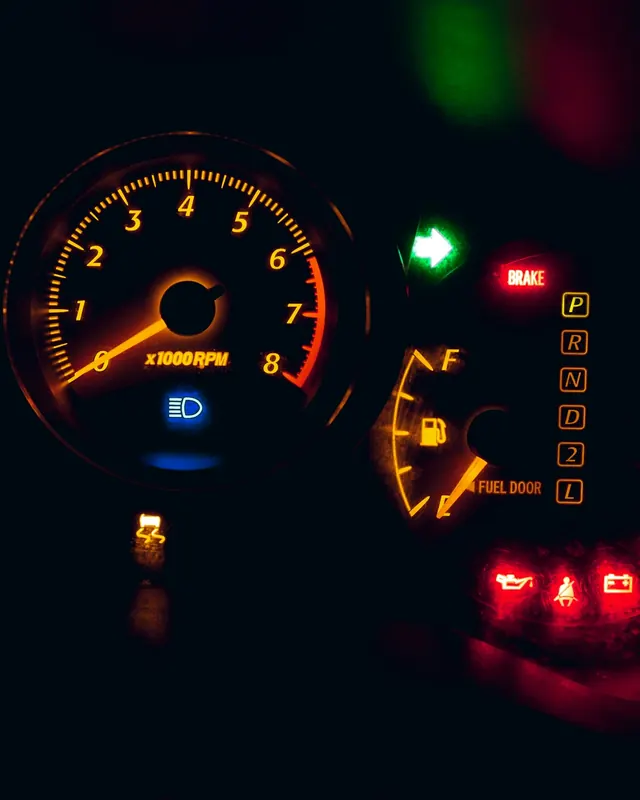
Dashboard Warning Lights: What Each Color Means and Which Ones Mean Pull Over
Photo: McCarthy Beckan on Unsplash
On this page
The short answer
Dashboard light colors work like a traffic light: red means stop and deal with it now, amber or yellow means get it checked soon, and green or blue just tells you a feature is on. Pull over and shut the engine off for a red oil pressure, engine temperature, charging or brake light, and ease off right away for a flashing check engine light.
A light just came on in the dash and you're not sure if it means "pull over now" or "deal with it next week." The color tells you most of what you need to know, and a handful of lights always mean stop. Here's how to read them, what you can check yourself, and when it's time to bring the car in.
What do the colors of dashboard warning lights mean?
The colors work like a traffic light. AAA describes red warnings as problems that need immediate action, amber (yellow or orange) as problems that need attention but can wait a little, and green or blue as status lights that just tell you a system is on.
- Red: stop as soon as it's safe and find out why. Driving on can damage the engine or affect braking or steering.
- Amber or yellow: the car has found a fault. It's usually OK to drive carefully to a shop, but don't put it off.
- Green or blue: information only. Headlights, high beams, cruise control, turn signals.
One exception people mix up: on many cars a blue thermometer means the engine is still cold, not that something is wrong. Drive gently until it goes out.
Which warning lights mean pull over right away?
These are the ones that need you to act right away. For all but the flashing check engine light, find a safe place to stop and turn the engine off. On I-15, take the next exit if you safely can; if not, use the shoulder as far from traffic as possible.
| Light | What it usually means | What to do |
|---|---|---|
| Oil can (red) | Engine oil pressure is too low | Pull over, shut it off, check the dipstick after a few minutes |
| Thermometer (red) | Engine is overheating | Pull over, shut it off, let it cool; don't open the radiator cap hot |
| Battery (red) | The charging system isn't charging | Pull over somewhere safe; the engine can stall once the battery runs down |
| Brake, "(!)" or BRAKE (red) | Parking brake on, low brake fluid or a brake fault | Check the parking brake first; if it stays on, don't drive it |
| Check engine, flashing | Usually a misfire | Ease off right away and get it checked; pull over if the car shakes or loses power |
| Power steering or steering warning | Steering assist fault | Stop safely; steering may get very heavy |
Low oil pressure is the one that does the most damage the fastest. AAA warns that driving with low oil pressure can destroy an engine quickly. If the oil level is fine and the light still comes back on, AAA's advice is to shut the engine off and call for a tow rather than drive on it.
The battery light is sneakier because the car keeps running for a while. It's running on whatever charge is left in the battery, and when that's gone it can stall and may not restart, possibly in traffic. Mazda's owner's manual, for one, says to pull over and not keep driving with the charging light on. Our post on signs your car battery is dying covers how to tell a battery problem from an alternator problem.
If the temperature light comes on, our overheating guide walks through what to do on the side of the road.
Is it safe to drive with an amber warning light on?
Usually yes, for a short, careful drive to get it checked. Amber lights mean a system has a fault, not that the car is about to fail. The common ones:
- Check engine (steady): something in the engine or emissions system is out of range. If the car drives normally, get it read soon. Our check engine light guide explains what to check first, starting with the gas cap.
- Tire pressure (a horseshoe with an exclamation point): one or more tires are low. Check all four with a gauge and fill them to the pressure on the driver's door sticker. A slow leak will bring it back, so watch for that.
- ABS: the antilock part of the brakes is off. AAA says your regular brakes should still work. You lose the antilock help, which matters most in a hard stop or on wet roads, so leave extra room.
- Traction or stability control (a car with squiggly lines): if it flickers while you're accelerating on a wet or loose road, the system is working. If it stays on, the system may be switched off or have a fault.
Amber doesn't mean ignore it. A steady check engine light can turn into a flashing one, and a slow tire leak usually gets worse, not better.
What about the airbag light?
The airbag (SRS) light is red on most cars, but it's a different kind of red. The car will drive normally. What it means, per AAA, is that the airbags may not work when you need them. Get the system checked soon. It isn't something to live with.
What can I check myself before calling a shop?
A few things are safe for anyone to look at once the car is parked and off:
- Parking brake. Make sure it's fully released. It's the most common reason the red brake light comes on.
- Oil level. Wait a few minutes after shutting off, then pull the dipstick. If it's low, top it up with the oil your owner's manual lists, without overfilling.
- Coolant level. Look at the see-through reservoir only when the engine is cool. Never open the radiator cap on a hot engine.
- Tire pressure. Check all four, plus the spare if your car has a sensor in it.
- Gas cap. Tighten it until it clicks if the check engine light just came on after a fill-up.
Your owner's manual has a page showing every symbol on your dash. Lights vary between brands, so if you see one that isn't in this post, that page is the place to look.
When to bring it in
Bring it in for any red light that doesn't clear after a simple fix like the parking brake, a flashing check engine light, a steady amber light that's been on more than a few days, or several lights coming on together. If the oil, temperature, brake or battery light is on, or the steering warning stays on after a restart, get it towed rather than driving it to us.
Here's what we do: read the stored codes and live data, then test the system the light points to. A battery light gets a battery and charging system test. A brake light starts with the fluid level and a look at the pads and lines. A check engine light gets the code read and then tested, since a code points to a system, not a specific part. You get a written estimate before any work starts. Start with our diagnostic service page or call us at (951) 445-8055.
Recent work like this at our shop
A few recent jobs from our service records. Vehicle, mileage and month only; no customer details.
| Vehicle | Work | Mileage | When |
|---|---|---|---|
| 2020 Ram 1500 | Thermostat | 108,493 mi | Jul 2026 |
| 2020 Cadillac XT6 | Thermostat | 47,722 mi | Jul 2026 |
| 2014 Infiniti Q50 | Thermostat | 140,443 mi | Jun 2026 |
| 2009 Toyota Camry | Brake inspection | 107,679 mi | Jun 2026 |
| 2025 Volkswagen Jetta | Brake inspection | 33,897 mi | Apr 2026 |
Common questions
Is it safe to drive with a red warning light on?
Usually not. AAA says red warnings call for immediate action. For the oil pressure, engine temperature, charging and brake lights, we'd pull over where it's safe and turn the engine off. The one common exception is the brake light caused by a parking brake that isn't fully released.
What's the difference between a yellow and a red warning light?
Red means a problem that needs action now, like low oil pressure or overheating. Yellow or amber means something needs attention soon but the car can usually be driven carefully to a shop, like a steady check engine light, low tire pressure or an ABS fault.
Why did all my dashboard lights come on at once?
When you turn the key, most lights come on for a few seconds as a bulb check and then go out. That's normal. If several lights come on together while you're driving, especially with the battery light, the charging system is a common cause because low voltage upsets several systems at once.
Can I keep driving with the ABS light on?
Your regular brakes should still work, but the antilock part may not, so the car can skid more easily in a hard stop or on wet roads. Leave more following distance and get it checked. If the ABS light and the red brake light are on together, don't drive it; have it towed.
Does a warning light that goes off by itself still need to be checked?
Often, yes. Some faults come and go before a part fails for good. For the check engine light and many others, the car's computer stores a code even after the light goes out, so a check can still find what happened.
Sources
More from the blog
P04B4 Code: What "Refueling Vapor Control Valve Stuck Closed" Means
Got a P04B4 code? What the refueling vapor control valve does on hybrids with a sealed fuel tank, what sets the code, whether it's safe to drive and what to check.
EVAP Leak Code (P0455, P0456, P0442): Is It Just the Gas Cap?
Check engine light with an EVAP leak code like P0455 or P0456? What the codes mean, the gas cap check, other common causes and how urgent it really is.
Signs Your Car Battery Is Dying (and How to Tell It's Not the Alternator)
Slow cranking, clicking, dim lights or a battery light? The signs of a dying car battery, why heat wears them out here, and how to tell battery from alternator.