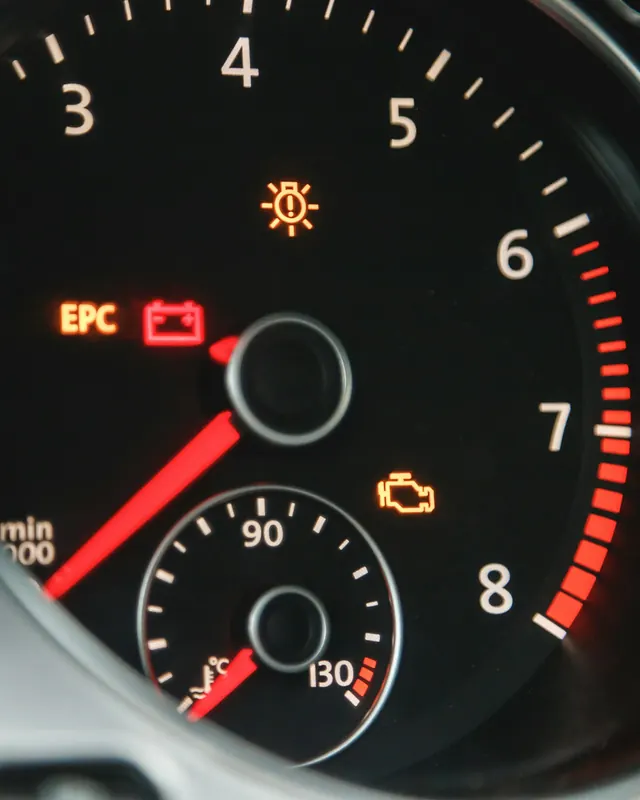
Check Engine Light On? What to Do and When to Stop Driving
Photo: Vlad Deep on Unsplash
On this page
The short answer
A steady check engine light means the car's computer found a problem worth checking soon, but if the car drives normally you can usually get it to a shop. A flashing light usually means a misfire that can damage the catalytic converter: ease off, avoid hard acceleration and get it checked right away. Pull over and shut it off if you also see smoke, smell something burning or the car runs badly.
The check engine light came on. Maybe you're on I-15, maybe you just started the car in a parking lot, and the car seems to drive fine. Here's how to tell whether you can keep going, what you can check yourself in a minute, and what a shop actually does with that light.
What does the check engine light mean?
It means the engine computer saw a reading outside its normal range and stored a trouble code. That's all the light itself tells you. The cause could be as small as a loose gas cap or as serious as a misfire that's overheating the catalytic converter.
Cars and light trucks from the 1996 model year on have this on-board diagnostic system, called OBD-II. It watches the engine, fuel system, ignition and emissions parts while you drive. When something fails a self-test, it turns on the light (officially the malfunction indicator lamp) and saves a code that a scan tool can read.
The light should also come on for a moment when you turn the key, then go out once the engine starts. That's a bulb check, not a problem.
Steady vs flashing: is it safe to drive?
Steady or flashing is the first thing to notice.
| What you see | What it usually means | What to do |
|---|---|---|
| Steady light, car drives normally | A problem worth checking soon | Short trips are usually fine; have it read soon |
| Steady light, car shakes or loses power | Something is affecting how the engine runs | Pull over when safe; don't keep driving it far |
| Flashing light, car otherwise drives normally | Usually an active misfire | Ease off, avoid hard acceleration, get it checked right away |
| Any light plus smoke, a burning smell or overheating | Something is failing now | Pull over when safe and shut the engine off |
AAA says it's OK to drive short distances with a steady light as long as nothing is noticeably wrong. With a flashing light it says to be cautious, and to pull over and shut the engine off if the car is also shaking, losing power, smoking or giving off a strange smell. California's Bureau of Automotive Repair (BAR) puts it the same way: a blinking or flashing light means a problem that should be addressed immediately to avoid serious damage.
Why the urgency with a flashing light: when a cylinder misfires, unburned fuel goes into the exhaust and burns inside the catalytic converter. That heat can melt the inside of the converter, turning a spark plug or coil repair into a much bigger one.
What should I check first?
A few things take a minute and need no tools:
- Look at the gauges. Check the temperature gauge and watch for an oil pressure or battery light. Those are separate warnings and more urgent than the check engine light alone.
- Notice how the car runs. Shaking at idle, hesitation, loss of power or a new smell are all worth mentioning when you bring it in.
- Check the gas cap. AAA lists a loose or faulty fuel cap as a common reason the light comes on. Take it off, look at the rubber seal for cracks, and tighten it until it clicks.
- Think about what changed. Did the light come on right after filling up, after a car wash, or after the first cold morning? Details like that help narrow it down.
If you tightened the cap, don't expect the light to go off immediately. Most cars need several drives for the system to retest itself. If the light is still on after a few days of normal driving, the cause is probably somewhere else.
What are the most common causes?
AAA's list of common causes includes the gas cap, an oxygen sensor, the catalytic converter, the mass airflow sensor and the battery. Here's what each of the usual suspects does:
- Evaporative emissions (EVAP) leaks. The gas cap, a cracked hose, or a purge or vent valve. The car usually drives fine, but the light stays on.
- Misfires. Worn spark plugs or a failing ignition coil. You'll often feel a shake, especially at idle or going up a grade.
- Oxygen sensors. They measure how much oxygen is left in the exhaust so the computer can adjust the fuel mix.
- Mass airflow sensor. It measures the air coming into the engine. A dirty or failing one can cause hesitation and poor fuel economy.
- Catalytic converter efficiency. Often the result of another problem, like a misfire that went on too long.
Isn't reading the code the same as a diagnosis?
No. A code tells you which system reported a problem, not which part failed. A code for a lean condition, for example, can come from a vacuum leak, a weak fuel pump, a dirty airflow sensor or a wiring problem. Swapping the part a code lookup names often doesn't fix it.
A proper diagnosis starts with the code, then looks at live data from the sensors, the freeze-frame data (a snapshot of conditions when the code set), and the history of other stored codes. Then it's testing: checking for vacuum leaks, measuring sensor signals, testing coils, or checking the EVAP system for a leak.
Can I clear the code before a smog check?
Clearing it won't get you through. BAR says readiness monitors must be rerun after things like disconnecting the battery, so a car that just had its codes cleared isn't ready to test. For 2000 and newer gas cars, only the EVAP monitor is allowed to be incomplete.
Many 2010 and newer cars also store permanent codes. According to BAR, these can't be erased with a scan tool or by disconnecting the battery; only the car's own system clears them once it confirms the problem is gone. BAR's advice is not to wait for your next smog check: if the light comes on, get the car repaired as soon as possible.
When to bring it in
Bring it in right away if the light is flashing, the car is running rough, or you see another warning light with it. If it's steady and the car drives normally, get it checked soon rather than waiting for it to go away.
With our check engine light diagnostics, we read the codes and freeze-frame data, check the obvious things like the gas cap and EVAP lines, then test the specific system that set the code. Once we know the cause, you get a written estimate before any work starts. If it turns out to be a misfire, that might mean spark plugs and coils under our engine repair service; if the converter is damaged, it's exhaust work.
If your battery light came on instead, our post on whether water can damage an alternator covers the charging-system signs. You can call us at (951) 445-8055 or book a visit online.
Recent work like this at our shop
A few recent jobs from our service records. Vehicle, mileage and month only; no customer details.
| Vehicle | Work | Mileage | When |
|---|---|---|---|
| 2022 Mazda CX-5 | Oxygen sensor | 122,003 mi | Apr 2026 |
| 2006 Chevrolet Avalanche | EVAP system repair | 151,636 mi | Mar 2026 |
| 2021 Nissan Sentra | Spark plugs | 96,298 mi | Mar 2026 |
| 2015 Chrysler 200 | EVAP system repair | 122,099 mi | Jan 2026 |
| 2012 Toyota Sienna | Spark plugs | 121,087 mi | Nov 2025 |
Common questions
Is it safe to drive with the check engine light on?
If the light is steady and the car feels normal, short trips to get it checked are usually fine. If it's flashing, ease off and get it checked right away. If the car is also shaking, losing power, smoking or smells like something is burning, pull over when it's safe and turn the engine off.
Can a loose gas cap turn on the check engine light?
Yes. A loose, cracked or missing cap lets fuel vapor escape, and the car's evaporative emissions system can flag it as a leak. Tighten the cap until it clicks. The light usually won't go off right away; many cars need several drives before the system rechecks itself.
Will the check engine light turn off by itself?
Sometimes. If the problem was temporary, like a loose gas cap, the light can go out after the car's self-tests pass again. The code stays stored in memory for a while, and if the problem is still there, the light comes back.
Can I just clear the code and pass a smog check?
No. California's Bureau of Automotive Repair says readiness monitors have to run again after things like disconnecting the battery, and clearing codes with a scan tool resets them the same way. A car that isn't ready can't pass. Many 2010 and newer cars also store permanent codes that a scan tool can't erase. Fixing the cause is the only reliable route.
Does a code tell you what part to replace?
Not by itself. A code says which system reported a problem, not which part failed. An oxygen sensor code can come from a vacuum leak, a fuel problem or wiring as easily as from the sensor itself. Testing finds the actual cause.
Sources
More from the blog

Can Water Damage Your Car's Alternator?
Rain won't hurt it, but deep water can. Signs of a failing alternator after driving through a flooded street, what to do before restarting, and when to call us.
How Often Should You Change Your Oil? (It's Probably Not 3,000 Miles)
The 3,000-mile rule is out of date for most cars. How to find your real oil change interval, when the severe schedule applies and why the once-a-year rule matters.
Car Overheating? What to Do Right Away (and What Not to Do)
Temperature gauge climbing or steam from the hood? What to do in the first minute, why the heater helps, why not to open a hot radiator cap and when to tow it.