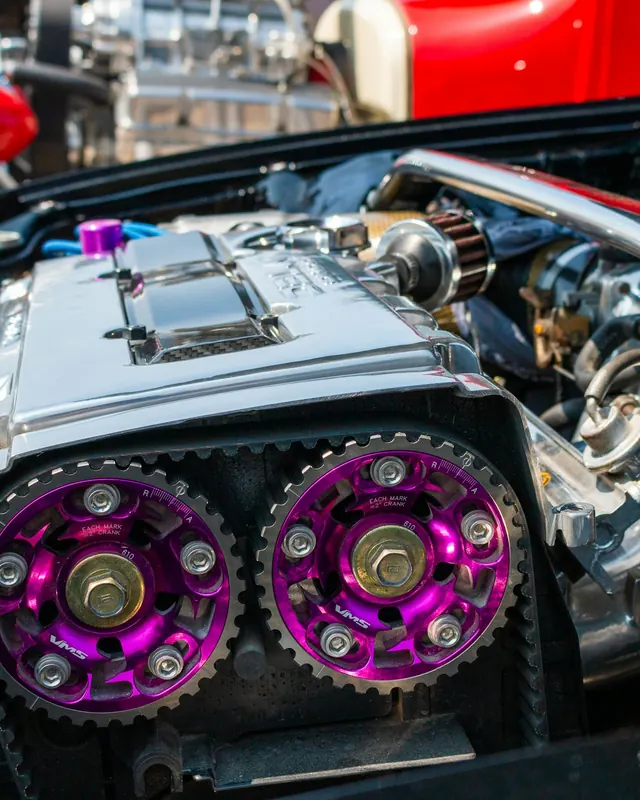
Timing Belt vs Timing Chain: Which One You Have and When It Needs Replacing
Photo: Dylan McLeod on Unsplash
On this page
- The short answer
- What's the difference between a timing belt and a timing chain?
- How can I tell if my car has a belt or a chain?
- When does a timing belt need to be replaced?
- What is an interference engine, and why does it matter?
- What does a bad timing chain sound like?
- Should the water pump be replaced with the timing belt?
- When to bring it in
- Recent work like this
- Common questions
The short answer
Both do the same job: they keep the crankshaft and camshafts in step. A timing belt is rubber and has a replacement interval, usually somewhere from 60,000 to 120,000 miles depending on the car, while a timing chain is metal, runs in engine oil and often lasts the life of the engine. To find out which you have, look for a timing belt line in your owner's manual maintenance schedule.
Maybe a friend asked if you've done your timing belt yet, or you're looking at a used car and the seller can't say. Here's how to find out which one your engine has, when it needs attention, and why the answer matters more on some engines than others.
What's the difference between a timing belt and a timing chain?
They do the same job with different materials. Each one links the crankshaft to the camshafts, so the valves open and close in step with the pistons. NAPA describes the belt as rubber reinforced with synthetic fibers, usually kept dry behind a cover, while the chain is metal and bathed in engine oil.
- Timing belt: fiber-reinforced rubber, and it's on the maintenance schedule, at about 60,000 to 120,000 miles depending on the car. It often fails with little warning. Keeping oil and coolant off it helps it last.
- Timing chain: metal, and usually not on a replacement schedule, since many last the life of the car. It tends to wear gradually and make noise first. Regular oil changes help it last.
Neither one is a reason to buy or skip a car. It just tells you what to plan for and what to listen for.
How can I tell if my car has a belt or a chain?
The owner's manual is the most reliable answer. Here's the order we'd go in:
- Read the maintenance schedule. Cars.com says to look for a line about changing the timing belt. If there isn't one, your car probably has a chain.
- Look up your exact car. Search the make, model and year, and include the engine size, since the same model can come with different engines. A dealer can also confirm it from your VIN.
- Look at the timing end of the engine. On most front-wheel-drive cars that's the side facing a front wheel, not the grille. Universal Technical Institute says a plastic timing cover often means a belt and a metal one often means a chain. That's a rule of thumb, not proof, and engine covers can hide the view.
Don't confuse the timing belt with the belt you can see. The ribbed belt on the front of most engines is the drive belt, also called a serpentine belt. It runs the alternator and other accessories, and it isn't the timing belt.
One exception is worth knowing. NAPA notes that some newer belts run in oil, though they aren't common yet. So a missing plastic cover doesn't prove you have a chain. Again, the manual settles it.
When does a timing belt need to be replaced?
Follow the number in your manual, because the range is wide. Cars.com says most belts are due every 60,000 to 120,000 miles. Underhood Service, a trade magazine for shops, says 60,000 was the traditional number and that many cars now go past 100,000. Some schedules also list a time limit, so check for that if you don't put many miles on the car.
Look for fine print about heat too. The 2009 Honda Odyssey manual, for example, says to replace the belt every 60,000 miles if you regularly drive in temperatures over 110°F. Every car is different, but with our summers in the valley, it's worth reading that part of your own schedule.
A belt doesn't always give you much notice. Underhood Service says the most predictable result of neglecting one is an engine that cranks but won't start. UTI lists a ticking noise, misfires or rough idling, hard starting and oil leaking near the timing cover as warning signs. If you notice those, don't wait for the mileage to come up.
What is an interference engine, and why does it matter?
On an interference engine, the pistons and valves use some of the same space, just at different moments. The timing belt or chain is what keeps them apart. If it breaks or jumps, the pistons can hit open valves. Cars.com says the pistons will usually bend some of the valves, and Underhood Service says the cylinder head then likely has to come off.
On a non-interference engine, a broken belt strands you, but Cars.com says no internal damage should occur.
The difference is why a belt interval matters so much more on some cars. You can't tell which type you have by looking, so ask us or look it up by engine. If yours is an interference engine, treat the interval as a hard deadline.
What does a bad timing chain sound like?
A rattle, usually right at startup. UTI lists rattling (especially on startup), a check engine light with timing-related codes, poor acceleration and worse fuel economy as signs. Chains usually wear gradually, and a stretched chain can eventually jump teeth on the sprocket, which throws the engine out of time.
NAPA says the chain itself rarely fails and that worn tensioners are far more common. Those parts take up slack in the chain. Since the chain depends on engine oil, staying on top of oil changes is the best thing you can do for it. UTI makes the same point: fresh oil helps prevent early wear on the guides and tensioners.
A startup rattle that's getting longer or louder is worth having checked soon, not someday. If it comes with a check engine light that flashes, a loud clatter while driving, or the engine stumbling or losing power, stop driving and have the car towed.
Should the water pump be replaced with the timing belt?
Many shops recommend it, and that includes the tensioner and idler pulleys the belt rides on. On many engines the timing belt turns the water pump, and the pump sits behind the same covers. Underhood Service says many shops make the seals and water pump a standard part of the job, and Cars.com says the cost of a later pump leak is mostly labor.
If the pump leaks later, it can also get coolant on the new belt, and contamination is one of the things that shortens a belt's life. Our post on coolant leak signs covers what to look for.
When to bring it in
Bring it in if your belt is at or past its interval, if you don't know whether it has ever been done, or if you hear a new rattle or ticking at startup. Oil or coolant leaking near the front of the engine is worth a look as well.
Here's what we do, in order:
- Confirm which your engine has, and look up its schedule.
- Check your records with you to see what's been done.
- Look over the front of the engine for leaks, and if there's a noise or a light, run a diagnostic.
- Give you a written estimate before any work starts. Our repairs carry a 1-year/12,000-mile warranty.
You can read more about our engine services or book a diagnostic if you've got a noise you want identified.
Recent work like this at our shop
A few recent jobs from our service records. Vehicle, mileage and month only; no customer details.
| Vehicle | Work | Mileage | When |
|---|---|---|---|
| 2020 Ram 1500 | Water pump | 108,493 mi | Jul 2026 |
| 2017 Chevrolet Equinox | Drive belt | 89,601 mi | Apr 2026 |
| 2012 Toyota Sienna | Drive belt | 121,087 mi | Nov 2025 |
| 2016 Nissan Altima | Drive belt | 98,266 mi | Aug 2023 |
| 2015 Honda Accord | Drive belt | 241,127 mi | Jun 2023 |
Common questions
How do I know if my car has a timing belt or a timing chain?
Check the maintenance schedule in your owner's manual. If it lists a timing belt replacement, you have a belt. If it doesn't, Cars.com says your car probably has a chain. You can also look up your make, model and year or give a dealer your VIN.
Do timing chains ever need to be replaced?
Usually not on a schedule, and Cars.com says many last the life of the car. They can still wear. The tensioners and guides tend to go before the chain itself, and a rattle at startup is the usual sign. Regular oil changes help a chain last, because engine oil is what lubricates it.
What happens if a timing belt breaks while driving?
The engine stalls right away and won't restart. On an interference engine the pistons can hit the valves and bend them, which usually means taking the cylinder head off. On a non-interference engine, no internal damage should occur, but you'll still need a tow and a new belt.
Should I replace the water pump with the timing belt?
Many shops recommend it, even if the pump isn't bad. The labor overlaps, so doing the pump later means paying for most of the same job twice. At a minimum it should be checked for leaks while the belt is off.
Is a serpentine belt the same as a timing belt?
No. The serpentine or drive belt is the one you can usually see on the front of the engine, running the alternator and other accessories. The timing belt sits behind a cover, and it's a much bigger job to reach.
Sources
- Cars.com, Timing Belt Vs. Timing Chain
- NAPA Know How, Timing Chain Versus Timing Belt, a Primer
- Universal Technical Institute, Timing Belt vs. Timing Chain
- Underhood Service, Timing Belt Replacement, Safeguarding Your Customers' Vehicles From Major Engine Damage
- Honda, 2009 Odyssey Owner's Manual, maintenance schedule
More from the blog
Coolant Leak Signs: Puddle Colors, Sweet Smells and What to Do
A colored puddle, a sweet smell or a reservoir that keeps dropping? How to spot a coolant leak, where it usually comes from and when it's not safe to drive.
Bad Thermostat Symptoms: Stuck Open vs Stuck Closed
Gauge stuck on cold, weak heat, or an engine that runs hot fast? How to tell a thermostat stuck open from one stuck closed, what P0128 means and when to fix it.
Why Is My Car's A/C Blowing Warm Air?
Car A/C blowing warm air? Common causes, from a refrigerant leak to a compressor that won't engage, what you can check yourself and why a recharge is not the fix.