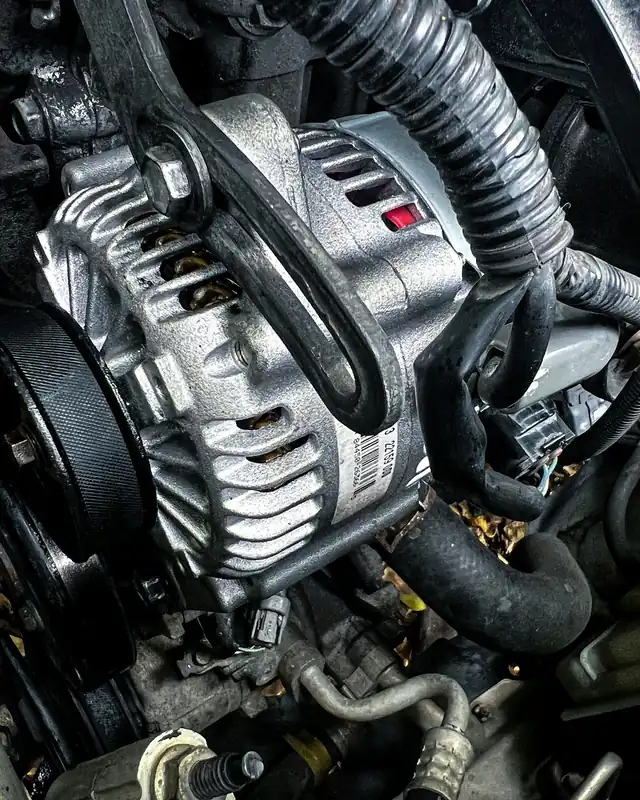
Signs of a Bad Alternator: Battery Light, Dim Lights and a Car That Keeps Dying
Photo: Manuel E Sankitts on Unsplash
On this page
- The short answer
- What does the alternator do?
- What are the signs of a bad alternator?
- What does it mean when the battery light comes on while driving?
- Is it the battery or the alternator?
- How can I check the alternator at home?
- What else can cause charging problems?
- When to bring it in
- Recent work like this
- Common questions
The short answer
A failing alternator usually shows up as a battery or charging warning light, headlights and dash lights that dim or flicker, slow power windows, a whine or squeal from the engine, or a car that dies soon after a jump-start. With the engine running, a healthy charging system reads about 13 to 14.5 volts at the battery. If the battery light comes on while you're driving, head somewhere safe and have the charging system tested before the battery runs flat.
The battery light flickers on at a stoplight, the headlights look a little yellow, or the new battery you bought last month is dead again. Any of those can point to the alternator, the part that keeps your battery charged while the engine runs. Below are the signs, how to tell it from the battery, and how far you can drive once the light is on.
What does the alternator do?
The alternator makes the electricity your car runs on once the engine is started. AAA Club Alliance describes it as a compact generator driven by a belt from the engine, powering everything from the headlights to the wipers and recharging the battery as you drive.
The battery's main job is starting the engine. After that, the alternator carries the load. When the alternator stops charging, the car keeps running on the battery alone until the battery is drained, which is why alternator trouble so often ends with a car that won't start.
What are the signs of a bad alternator?
The most common signs of a failing alternator are a warning light, dim or flickering lights, and electrical accessories acting up. AAA's guides list these:
- Battery or charging warning light. It can come on when the alternator can't keep the battery at the right voltage. Some cars also show a "check charging system" message, and the check engine light may come on.
- Dim, flickering or overly bright lights. Headlights, dash lights or the dome light may dim, flicker or brighten as the alternator's output swings.
- Slow or erratic accessories. Power windows that crawl, or a radio or infotainment screen that cuts out, especially with several things switched on at once.
- A whine, groan or squeal from the front of the engine.
- A burning rubber or hot wire smell.
- Stalling while driving.
- A battery that keeps going dead, even a newer one.
One sign alone isn't proof. Loose or corroded battery cables can mimic a failing alternator, and AAA says the symptoms overlap enough that the charging system should be tested.
What does it mean when the battery light comes on while driving?
A battery light while driving usually means the car isn't charging, and you're now running on the battery's stored power. AAA's Via magazine says the light indicates a charging issue and can be caused by the alternator, its voltage regulator, a worn drive belt, wiring problems or something draining power.
How long the battery lasts depends on its condition and what's switched on. Turn off what you don't need (rear defrost, seat heaters, the radio) and get somewhere safe rather than starting a long drive. If the car stalls, AAA says not to keep driving it.
If the temperature gauge also climbs, pull over and shut the engine off. On many engines one belt drives both the alternator and the water pump, so a broken belt can cause both warnings at once.
Is it the battery or the alternator?
What happens after a jump-start is the best clue. A car that runs after a jump but won't restart once you turn it off points to the battery, while a car that dies right after a jump points to the alternator, per AAA Club Alliance.
| What you notice | More likely |
|---|---|
| Starts after a jump, won't restart later | Battery not holding a charge |
| Dies soon after a jump while running | Alternator not charging |
| Battery light on while driving | Charging system (alternator, belt or wiring) |
| Lights dim more as you add accessories | Alternator output |
| White or green crust on the terminals | Battery or its connections |
| Battery case bulging | Battery, often from overcharging |
Battery age matters too. AAA Club Alliance says batteries should be replaced every 3 to 5 years, so a five-year-old battery is a suspect on its own. Our post on signs your car battery is dying covers the battery side, and car won't start, just clicks covers the starter.
The two problems feed each other. A weak alternator leaves the battery drained over and over, which shortens its life, and AAA's Via magazine notes that driving on a failing alternator can damage the battery as well.
How can I check the alternator at home?
You can get a good first read with a basic multimeter at the battery. Denso, which makes alternators, gives these numbers in its charging system guide:
- Ignition on, engine off: Denso lists 12.0 to 12.6 volts as normal, with 12.6 being a fully charged battery. Below 12 volts can mean the battery is low, it isn't being charged, or there's a wiring problem.
- Engine running: the reading should rise to 13.0 to 14.5 volts.
- Below 13.2 volts with the engine running may mean a failed alternator or a corroded, loose or broken connection.
- Above 14.5 volts may point to a failed voltage regulator, a bad battery or a poor connection. Overcharging damages a battery too.
Also watch the warning light. Denso says it should light up with the key on and engine off, then go out shortly after the engine starts. Keep hands, hair and loose clothing clear of the belt and fan whenever the engine is running.
A voltmeter shows whether the alternator is charging at that moment. It won't show an alternator that drops out only when it's hot or under heavy load, which is why a shop test runs the charging system with the lights, blower and defrost on.
What else can cause charging problems?
Not every charging problem is the alternator itself. Denso and AAA point to these:
- The drive belt. A belt that's loose, worn or cracked can slip on the pulley, so the alternator charges unevenly or not at all. Denso notes a belt that's too tight can damage the alternator's bearings. AAA Club Alliance suggests checking the belt visually from time to time.
- Wiring and grounds. Corroded, loose or broken cables and ground straps between the battery and engine, and from the body to the frame.
- Fuses and fusible links in the charging circuit.
- Added accessories. Denso says aftermarket add-ons such as extra lights, a fridge or other plug-in electronics can overwork the alternator and wear it out early, and poorly installed ones cause charging problems of their own.
If your car went through deep water recently, our post on whether water can damage an alternator covers what to watch for.
When to bring it in
Bring it in if the battery light comes on and stays on, the lights keep dimming, the car has needed more than one jump, or you've replaced the battery and it's going flat again. If the light came on while driving, call us before driving far so we can talk through whether it's safe to bring it over.
Here's how we check it, in order:
- Battery first. Age, case, terminals, and a test of whether it can still deliver power under load.
- Charging output. Alternator voltage at idle and with the electrical load on.
- Belt and pulleys. Wear, cracks, tension and the tensioner.
- Wiring, grounds and fuses in the charging circuit.
Then we tell you what needs doing now and what can wait. You get a written estimate before we do any work, and repairs come with our 1-year/12,000-mile warranty. See our diagnostic page, or call (951) 445-8055.
Recent work like this at our shop
A few recent jobs from our service records. Vehicle, mileage and month only; no customer details.
| Vehicle | Work | Mileage | When |
|---|---|---|---|
| 2017 Chevrolet Equinox | Drive belt | 89,601 mi | Apr 2026 |
| 2005 Nissan Frontier | Battery | 98,202 mi | Mar 2026 |
| 2012 Toyota Sienna | Drive belt | 121,087 mi | Nov 2025 |
| 2016 Hyundai Sonata | Alternator | 212,891 mi | May 2025 |
| 2004 BMW 645Ci | Battery | 159,684 mi | May 2024 |
Common questions
What are the first signs of a bad alternator?
Usually the battery or charging warning light, or lights that dim, flicker or get brighter as the engine speed changes. Power windows and other accessories may also slow down or act up when several are on at once. A whine or squeal from the front of the engine can come with it.
How do I know if it's the battery or the alternator?
If the car runs after a jump but won't restart once you shut it off, the battery is the likely problem. If it dies soon after a jump while still running, suspect the alternator. With a multimeter, Denso lists 13.0 to 14.5 volts with the engine running as normal; a reading below 13.2 volts may mean a failed alternator or a bad connection.
Can I drive with a bad alternator?
Only as far as the battery's stored charge lasts. Once the alternator stops charging, the car runs on what's left in the battery, and when that's gone the engine can stall. AAA says not to keep driving after a car has stalled. If the battery light comes on, turn off what you don't need and get somewhere safe.
Will a new battery fix a bad alternator?
No. A new battery will start the car, but if the alternator isn't charging, the new battery will run down too. When a battery keeps dying, AAA Club Alliance advises not to assume the battery is the problem and to have the alternator checked as well.
What does a bad alternator sound like?
Drivers often describe a whine, groan or squeal from the front of the engine. AAA Club Alliance says a squeal that gets worse as you turn on accessories may point to failing alternator bearings, and groans or whining can mean a belt, bearing or bushing needs replacing.
Sources
More from the blog
Car Won't Start, Just Clicks? What a Single Click vs Rapid Clicking Means
Turn the key and hear one click, fast clicking or nothing at all? What each sound usually points to, how to jump-start safely and when to have it tested.
Dashboard Warning Lights: What Each Color Means and Which Ones Mean Pull Over
Red, amber or green? What dashboard warning light colors mean, the lights that mean pull over now, and which ones can wait for a shop visit.
P04B4 Code: What "Refueling Vapor Control Valve Stuck Closed" Means
Got a P04B4 code? What the refueling vapor control valve does on hybrids with a sealed fuel tank, what sets the code, whether it's safe to drive and what to check.