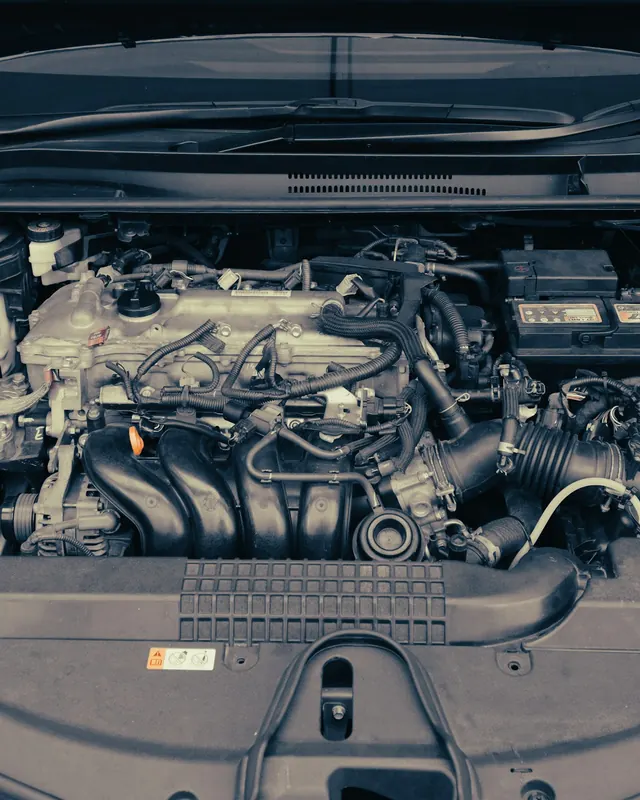
Signs Your Car Battery Is Dying (and How to Tell It's Not the Alternator)
Photo: Bharat Vishawakarma on Unsplash
On this page
The short answer
The most common signs of a dying car battery are an engine that cranks slowly, a click when you turn the key, dim lights at idle, the battery warning light, and needing jump-starts. AAA says batteries usually last three to five years, closer to three in hot climates like ours, so a battery past its third summer is worth testing before the first cold mornings.
You turn the key and the engine turns over a little slower than it used to. Or it starts fine every afternoon but hesitates on a cool morning. Those are often the first signs of a battery on its way out. Here's what to look and listen for, why batteries wear out faster in the Inland Empire, and how to tell a weak battery from a charging problem.
What are the signs of a dying car battery?
The most common sign is slow cranking: the engine turns over sluggishly before it starts. AAA lists slow cranking along with these other warning signs:
- A clicking noise when you turn the key, which can also mean a bad connection.
- Dim headlights, especially at idle. On cars with older-style bulbs this is easier to see.
- The battery or charging warning light on the dash.
- Needing jump-starts. AAA calls frequent jump-starts a clear sign the battery is struggling.
- A rotten egg or sulfur smell near the battery, which can mean it's damaged.
- A swollen or bulging battery case, often a sign of overheating or overcharging.
The Car Care Council adds two more: interior lights that dim, and accessories that stop working. You might also notice the clock or radio presets resetting, or a start-stop system that stops shutting the engine off at lights.
Here's what the most common symptoms usually point to:
| What happens when you turn the key | Most likely cause |
|---|---|
| Slow, labored crank, then it starts | Weak or aging battery |
| Rapid clicking, dash lights flicker | Battery too low, or a loose or corroded cable |
| One click, lights stay bright, no crank | Starter or its wiring |
| Cranks normally but won't start | Usually not the battery (fuel, spark or sensors) |
| Starts fine, then dies while driving | Charging system, often the alternator |
Why do car batteries die faster here?
Heat. It surprises a lot of people, but the Car Care Council says heat, more than cold, shortens battery life. Heat evaporates the fluid inside the battery and damages its internal parts. AAA notes that temperatures under the hood can pass 200°F in hot weather.
That's why location matters so much. AAA says batteries may last five years or longer in cooler northern climates, but around three years is more typical in southern ones. AAA figures cited by Consumer Reports put typical battery life at less than 41 months in the most southern parts of the country.
So why do they seem to die in winter? A summer of 100-degree days in Lake Elsinore and Menifee does the damage. Then cold slows the battery's chemistry and makes the engine harder to turn, and a battery that was already weak can't keep up. The first chilly morning in November is when a lot of people find out.
Short trips don't help. AAA says a battery in a car driven mostly on short trips may not fully recharge, and a car that sits for weeks slowly drains on its own.
How long should a car battery last?
AAA's general rule is three to five years, with the low end more likely in a hot climate. Since many batteries don't give much warning before they fail, AAA recommends testing the battery every year once it reaches three years old. Consumer Reports goes further for warm climates: an annual load test once it's two years old.
To find your battery's age, look for a date sticker or code on the case. Consumer Reports gives an example: a battery made in October 2018 carries a code like 10-8 or K-8, depending on the brand's format. If you can't find it, your service records may show when it was last replaced.
Is it the battery or the alternator?
The battery starts the car; the alternator powers the car's electrical system and recharges the battery once the engine is running. A few clues help you tell them apart:
- Won't start after sitting, runs fine once jumped: usually the battery.
- Battery light on while driving, lights dimming, car stalls on the road: usually the charging system (the alternator, its belt or the wiring).
- New battery that keeps going dead: suspect the charging system or something drawing power with the car off.
The two problems can feed each other. The Car Care Council points out that a faulty voltage regulator can overcharge a battery, and overcharging damages it as quickly as undercharging. That's why it's worth testing both before replacing either one. If your car went through deep water recently, see our post on whether water can damage an alternator.
What can I check myself?
A few things are safe to check in the driveway with the engine off:
- Look at the terminals. White, green or blue crust is corrosion. The Car Care Council says corrosion on the terminals blocks current flow.
- Wiggle the cables. Both should be snug on the posts. A loose clamp can cause clicking and no-starts.
- Check the case for swelling, cracks or leaks. If it's bulging or you smell sulfur, don't try to jump it. Have it looked at.
- Read the voltage if you have a multimeter. A fully charged battery at rest (wait a few hours after driving) usually reads around 12.6 volts. AAA says a battery typically needs replacing once its charge drops below 25 percent, around 11.8 volts at 80°F.
A voltage reading tells you the charge, not whether the battery can still deliver power under load. That takes a load test or a battery tester.
If you jump-start the car, follow the steps in your owner's manual. Some cars have specific jump points under the hood rather than at the battery itself.
How do I make my battery last longer?
- Keep the top of the battery clean and the connections tight. The Car Care Council notes that dirt on the case can slowly drain power.
- Make sure it's held down firmly. AAA says excessive vibration can shorten battery life.
- Drive long enough to recharge it now and then, especially if most of your trips are short runs around town.
- Don't let it go fully dead. AAA says that shortens a battery's life significantly.
- Replace it with one rated at least as high as the original, as the Car Care Council recommends. Your owner's manual lists the size and rating.
You can ask us to test the battery when you come in for an oil change, and it's on our winter car prep list too.
When to bring it in
Bring it in if the engine cranks slowly, you hear clicking, the battery light comes on, or you've needed a jump. Also bring it in if the battery is three or more years old and hasn't been tested this year.
Here's how we check it, in order:
- Look at the battery: age, case, terminals, cables and hold-down.
- Test the battery to see whether it can still deliver the power to start the car.
- Test the charging system: alternator output, the belt that drives it, and the connections.
- Check for a drain if a good battery keeps going flat.
- Tell you what we found and what needs doing now versus what can wait.
You get a written estimate before we do any work, and repairs come with our 1-year/12,000-mile warranty. See our diagnostic page, or call (951) 445-8055.
Recent work like this at our shop
A few recent jobs from our service records. Vehicle, mileage and month only; no customer details.
| Vehicle | Work | Mileage | When |
|---|---|---|---|
| 2017 Chevrolet Equinox | Drive belt | 89,601 mi | Apr 2026 |
| 2005 Nissan Frontier | Battery | 98,202 mi | Mar 2026 |
| 2012 Toyota Sienna | Drive belt | 121,087 mi | Nov 2025 |
| 2016 Hyundai Sonata | Alternator | 212,891 mi | May 2025 |
| 2004 BMW 645Ci | Battery | 159,684 mi | May 2024 |
Common questions
How long does a car battery last in Southern California?
AAA puts the usual range at three to five years and says around three years is more typical in hot southern climates. AAA figures cited by Consumer Reports put typical battery life at less than 41 months in the most southern parts of the country. Summers over 100°F in the valley are a big part of why a battery here can give out sooner than the same one would up north.
Can a car battery die without warning?
Yes. AAA notes that not every failing battery shows obvious symptoms. A battery can start the car fine on a warm afternoon and then fail on the first cold morning. That's why AAA suggests testing it every year once it's three years old.
Why does my car click but not start?
A rapid clicking usually means there's enough power to work the starter's switch but not enough to turn the engine: a weak battery or a loose or corroded cable. AAA also points to a bad connection when you hear clicking. A single click with lights that stay bright can point to the starter instead, which a test sorts out.
If a jump-start works, is my battery bad?
Not always. A good battery can go flat from a light left on or a car that sat for weeks. If the car needs a jump again within a few days, or the battery is three years old or more, have the battery and charging system tested. AAA calls frequent jump-starts a clear sign the battery is struggling.
Is it the battery or the alternator?
A car that won't start after sitting but runs fine once jumped usually points to the battery. A car that dies while driving, or shows the battery light with the engine running, points to the charging system. A test of the battery, alternator output and connections tells you which one it is before anything gets replaced.
Sources
More from the blog
Check Engine Light On? What to Do and When to Stop Driving
Steady or flashing check engine light? What each one means, the gas cap check, what a code read does and doesn't tell you, and when to pull over.
Can Water Damage Your Car's Alternator?
Rain won't hurt it, but deep water can. Signs of a failing alternator after driving through a flooded street, what to do before restarting, and when to call us.
Is My Transmission Slipping? Signs, Causes and What to Do
Engine revs but the car doesn't speed up? How a slipping transmission feels, what to check yourself, what causes it and when to stop driving it.