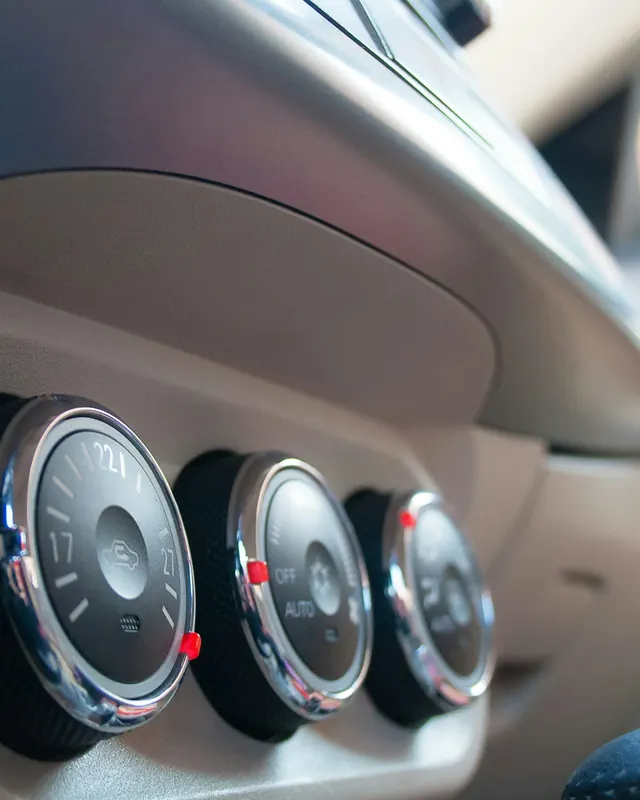
Why Is My Car's A/C Blowing Warm Air?
Photo: Shadow Photography on Unsplash
On this page
The short answer
The most common reason a car's A/C blows warm air is low refrigerant, and refrigerant only gets low when it leaks out. Other causes are a compressor that isn't engaging, a cooling fan or blocked condenser that can't get rid of heat, and a blend door stuck on heat. A recharge alone can bring the cold back for a while, but it doesn't fix the leak.
You turn the A/C to max and the air coming out is barely cool, or flat-out warm. Afternoons in the valley stay hot well into October, so this can come up most of the year. Here's what usually causes it, what you can check in the driveway, and why a can of refrigerant is rarely the real fix.
Why is my car A/C blowing warm air?
The most common cause is low refrigerant, and refrigerant gets low for one reason: it leaked out. The A/C is a sealed system, so it doesn't use refrigerant up the way an engine uses fuel. When the level drops far enough, the system can't absorb heat from the cabin, and on many cars it shuts the compressor off to protect it.
The other usual causes:
| What you notice | Likely cause |
|---|---|
| Slowly got weaker over weeks or months | Small refrigerant leak |
| Warm all the time, compressor clutch doesn't click on | Compressor not engaging (clutch, fuse, relay, pressure switch or wiring) |
| Cold on the freeway, warm at a stop | Cooling fan not running, or a blocked condenser |
| Cold on one side, warm on the other | Blend door or its actuator behind the dash |
| Cold but very little airflow | Clogged cabin air filter or a weak blower |
| Squeal or grind when the A/C is on | Drive belt or compressor problem |
Low airflow is a different problem from warm air. If the air is cold but barely comes out, start with the cabin air filter. AAA notes that a dirty one limits airflow through the vents, and that it typically sits behind the glove box.
Is it low refrigerant or something else?
Low refrigerant tends to come on gradually. The A/C gets a little weaker each week until one day it's warm. A sudden change from cold to warm points more toward something electrical or mechanical: a blown fuse, a failed relay, a compressor clutch that stopped engaging, or a fan that quit.
A leak is often hard to see. Refrigerant is a gas once it escapes, so there's no puddle. What sometimes shows is an oily, dirty spot on a hose fitting, the compressor, or the condenser, because the system's oil travels with the refrigerant and leaks out with it. The EPA says technicians can find leaks most of the time, especially with an electronic leak detector, but small ones can be hard to pin down even with good equipment.
What can I check myself?
A few things are safe to look at with the engine running and the A/C on max, and they help a shop narrow it down. Keep hands, hair and loose clothing away from the belt and fan; the fan can switch on by itself.
- Listen for the click. With the hood up and the engine idling, have someone press the A/C button. On cars with a compressor clutch (most older cars and many newer ones), you should hear a click from the compressor at the front of the engine and see its center hub start spinning. No click and no spin means the compressor isn't engaging. Some newer cars have no clutch, so the front of the compressor always spins and there's no click; skip this check if yours looks like that.
- Look at the fan. With the A/C on, many cars run the cooling fan behind the radiator. If it never comes on, that can explain warm air at idle.
- Look at the condenser. It sits in front of the radiator, behind the grille. AAA says bugs, dirt and road debris can clog it. Leaves and plastic bags stuck there block airflow too.
- Check the cabin air filter if airflow is weak. Your owner's manual shows where it is and how often to change it.
- Note when it's warm. All the time, only at idle, only on one side, or only after a long drive.
Should I recharge my car A/C with a can from the store?
It can bring the cold back for a while, but it doesn't fix why the refrigerant was low. The EPA says topping off or recharging can improve cooling, but neither service permanently fixes refrigerant leaks. Repairing or replacing the leaking part is what lasts.
There are a few other reasons to be careful:
- Too much is as bad as too little. The EPA says undercharging or overcharging both hurt how the system performs. The gauge on a store can reads only one side of the system, so it's easy to overfill.
- Sealers. Some cans include leak sealer. Tell the shop if you've used one, because it affects how the system has to be serviced.
- Not all cars use the same refrigerant. Many newer cars use a refrigerant called HFO-1234yf instead of the older R-134a. The EPA notes it's mildly flammable but can be used safely, and that each refrigerant has its own service fittings so they don't get mixed. A label under the hood shows which one your car takes and how much.
- If the compressor isn't engaging, refrigerant may not be the problem. Adding more to a system that's already full won't help.
Can I drive with the A/C not working?
Usually, yes. Warm air by itself isn't a safety problem. Stop using the A/C and get it looked at if:
- You hear grinding, rattling or a loud squeal when the A/C is on.
- You smell something burning.
- The engine temperature gauge climbs when the A/C runs. If that happens, turn the A/C off and see what to do when your car is overheating.
One more thing: on many cars the defroster uses the A/C to dry the air, so a dead A/C can make foggy windows slower to clear. Once the rainy season starts, that matters. Our winter prep checklist covers wipers, defrost and the rest.
How do I keep my car A/C working?
Run it for a few minutes now and then, even in cooler months, so oil keeps circulating to the seals. And have it looked at when it first starts to feel weaker instead of when it's blowing hot. AAA suggests having the A/C inspected once a year for leaks and the right refrigerant level, and changing the cabin air filter on the schedule in your owner's manual.
A few habits help the A/C keep up on hot days. FuelEconomy.gov says to park in the shade or use a sunshade, and to drive with the windows open for a short time before using the A/C so the hot air gets out first. It also says not to idle with the A/C running before you drive.
When to bring it in
Bring it in once the air isn't as cold as it used to be, or right away if it went warm suddenly, makes noise, or you've already added refrigerant and it's warm again. That last one usually means there's a leak, or the system was overfilled.
Here's what we check, in order:
- Whether the compressor engages, and the fuses, relays and wiring that control it.
- Refrigerant pressures with gauges on both sides of the system.
- A leak check of the hoses, fittings, compressor, condenser and evaporator.
- The cooling fan, the condenser and the drive belt.
- Airflow and temperature at each vent, the cabin air filter and the blend doors.
You get a written estimate before we do any work, and repairs come with our 1-year/12,000-mile warranty. See our diagnostic services or all services, or call (951) 445-8055.
Recent work like this at our shop
A few recent jobs from our service records. Vehicle, mileage and month only; no customer details.
| Vehicle | Work | Mileage | When |
|---|---|---|---|
| 2020 Honda Civic | A/C repair, A/C service | 63,307 mi | Jul 2026 |
| 2017 Chevrolet Equinox | Drive belt | 89,601 mi | Apr 2026 |
| 2012 Toyota Sienna | Drive belt | 121,087 mi | Nov 2025 |
| 2022 Mercedes-Benz GLE350 | Cabin air filter | 50,499 mi | Oct 2025 |
| 2020 Toyota Camry | A/C repair, A/C service | 118,050 mi | Jul 2025 |
Common questions
Why is my car A/C cold while driving but warm at a stop?
At speed, air is pushed through the condenser in front of the radiator. At a stop, the car depends on the cooling fan to pull that air through. A/C that only goes warm at idle often points to a fan that isn't running, or a condenser blocked by dirt, bugs or debris.
Does car A/C refrigerant need to be topped off regularly?
No. The A/C is a sealed system, and refrigerant isn't used up as it runs. If it's low, some of it leaked out. The EPA notes that topping off or recharging can improve cooling, but neither service permanently fixes refrigerant leaks.
Can I use a can of refrigerant from the parts store?
You can, but it's a guess. The gauge on a can only shows part of the picture, and the EPA says undercharging or overcharging both hurt how the system performs. If you've already added a can, especially one with leak sealer in it, tell the shop before they connect their equipment.
Why is my car A/C blowing cold on one side and warm on the other?
Usually a blend door or its small electric motor (the actuator) behind the dashboard. On cars with separate driver and passenger temperature settings, each side has its own door. A clicking or tapping sound behind the dash when you change the temperature is a common sign.
Is it safe to drive with the A/C not working?
Usually yes, if the only problem is warm air. Stop running the A/C and get it checked if you hear grinding or squealing when it's on, smell something burning, or see the engine temperature rising. If you stop using the A/C, remember that on many cars the defroster uses it to dry the air, so foggy glass may clear more slowly.
Sources
More from the blog
Car Overheating? What to Do Right Away (and What Not to Do)
Temperature gauge climbing or steam from the hood? What to do in the first minute, why the heater helps, why not to open a hot radiator cap and when to tow it.
How Often Should You Change Your Oil? (It's Probably Not 3,000 Miles)
The 3,000-mile rule is out of date for most cars. How to find your real oil change interval, when the severe schedule applies and why the once-a-year rule matters.
Why Do My Brakes Squeak? What Each Brake Noise Means
Squealing, grinding, clicking or scraping when you brake? What each noise usually means, which can wait and which mean stop driving, from our Lake Elsinore shop.