Oil Leak Under Your Car? Where the Drip Is and What It Usually Means
Photo: Erik Mclean on Unsplash
On this page
The short answer
An oil leak usually shows up as amber, brown or black spots that feel slick and stain the driveway, most often under the front half of the car. Common sources are the valve cover gasket, the oil pan and its gasket, the drain plug, the oil filter and the crankshaft seals. A few drops can be watched while you check the dipstick, but a growing puddle, a burning smell or a falling oil level needs a shop soon.
You back out of the driveway and there's a dark spot where the engine sat. Maybe it's a few drops, maybe it's the size of your hand. Most of the time it's engine oil, and AAA calls the oil leak the most common wet patch under a car. Here's how to confirm it, where it's probably coming from, and how to tell a leak you can watch from one that needs attention this week.
How do I know the spot under my car is engine oil?
Engine oil is amber when it's fresh and turns dark brown or black as it ages. It feels slick, it's hard to wipe off your fingers, and it leaves a dark stain on concrete. AAA describes the smell as burnt, similar to cooking oil.
The easy test is a white paper towel. Dab the spot and look at the color against the white. AAA Club Alliance also suggests noting where the spot is under the car, because location narrows things down fast.
| What you see | Usually means |
|---|---|
| Amber, brown or black, slick, stains concrete | Engine oil |
| Green, yellow, orange or pink, smells sweet | Coolant (see our post on coolant leak signs) |
| Red or reddish brown | Transmission fluid (often under the middle) or power steering fluid (front) |
| Clear water, no smell, front passenger side | A/C condensation, normal |
If the spot is dark but you're not sure, slide a big piece of flattened cardboard under the engine overnight. You'll get a clean sample in the morning and a rough map of where it dripped.
Where do oil leaks usually come from?
Oil leaks usually come from a gasket or seal that has aged. Engines are built from metal parts bolted together, with gaskets between them to keep oil in. As a car gets older, Cars.com explains, those gaskets often shrink, harden or break apart. MotorWeek makes the same point: seals wear and gaskets shrink over time.
The most common sources, roughly from top to bottom:
- Valve cover gasket. The valve cover sits on top of the engine. Oil seeps out along its edge and runs down the side of the engine, which is why the drip often shows up well below where it started.
- Timing cover. On the front of the engine, behind the belts and pulleys.
- Oil filter. A filter that's loose, double-gasketed or damaged will drip near the bottom of the engine.
- Oil pan, pan gasket and drain plug. The pan is the lowest part of the engine. The gasket along its top edge can seep, the drain plug and its washer can leak, and a pan that took a hit from a rock or curb can crack.
- Crankshaft seals. There's one at each end of the engine. The rear main seal sits between the engine and the transmission, so a leak there shows up near the middle of the car and the fix usually means removing the transmission.
One thing to keep in mind: the drip may not be directly under the leak. Cars.com notes that fluid can run down a slanted surface before it reaches the ground. A spot under the front of the pan might start at the valve cover.
Why is my car leaking oil after an oil change?
A leak that starts right after an oil change is most often the drain plug or the oil filter. Cars.com lists a drain plug that wasn't tightened properly and a filter that wasn't installed right as the usual causes. Oil spilled on the engine or the plastic splash shield during the service can also drip for a day or two and then stop.
If the spots keep coming after a couple of days, have the plug, its washer and the filter looked at. A shop can check them on a lift, which beats driving around with a filter that's working loose. You can read more about our oil change service and our guide to how often to change your oil.
Is it safe to drive with an oil leak?
A small, slow oil leak is usually safe to drive on for now, as long as the oil level stays in range. AAA says it's normal for oil to leak in very small amounts, and AAA Club Alliance says a drop or two under the car is no reason to hit the panic button yet. Keep an eye on it so it doesn't grow.
Stop driving and call a shop if:
- The oil pressure warning light comes on (the red oil can symbol).
- The dipstick reads below the low mark, or there's no oil on it at all.
- You see smoke from under the hood, or smell strong burning oil while driving.
- The puddle is big enough to spread, or it's dripping steadily while the engine runs.
Low oil is the bigger risk. AAA warns that running on low or no oil can cause serious engine damage that can't be repaired. There's also a fire concern. Cars.com points out that oil can catch fire if it drips onto a hot exhaust manifold, which is exactly where a leaking valve cover gasket tends to drip on many engines. On a hot day in the valley, after a climb up Ortega Highway or a stretch of stop-and-go on I-15, those exhaust parts get very hot.
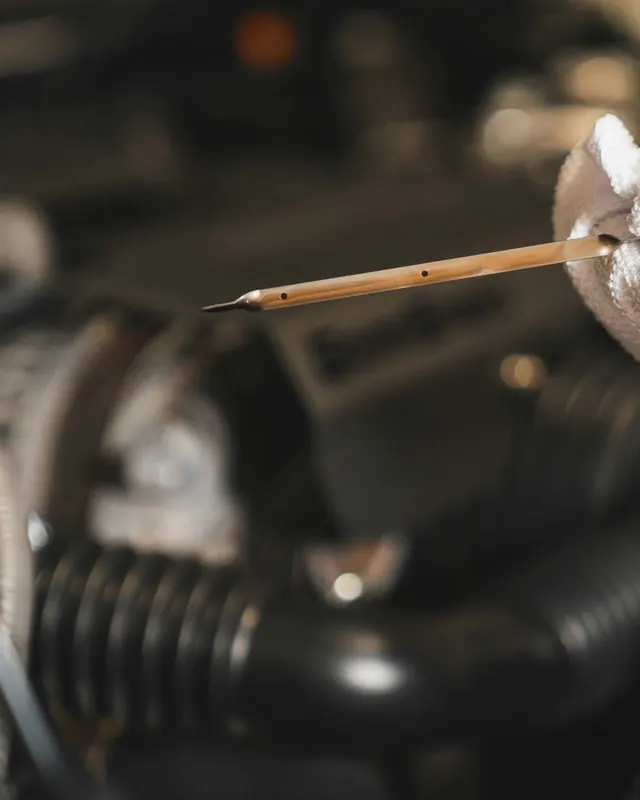
How do I check my oil level?
Checking the dipstick is the most useful thing you can do while you decide on a repair. It takes two minutes:
- Park on level ground and shut the engine off. Many owner's manuals say to wait a few minutes so the oil drains back to the pan; check yours for the exact steps.
- Pull the dipstick (usually a yellow or orange loop handle), wipe it clean with a rag, push it all the way back in, and pull it out again.
- Read where the oil sits between the two marks. Between them is fine. At or below the low mark, add the oil type your manual lists, a little at a time, and recheck.
- Write down the date, the mileage and how much you added.
That log is what AAA recommends: top off and keep track of how much oil the car uses. If you're adding oil every week, the leak is bigger than it looks. Some newer cars have no dipstick and show the oil level on the dash instead; your owner's manual explains how.
A falling level with no spot under the car points somewhere else: oil burning off on hot parts before it reaches the ground, or oil being burned inside the engine. Bluish smoke from the tailpipe, especially on startup, is a clue for the second one.
When to bring it in
Bring it in soon if the spots are getting bigger, you smell burning oil, or you're topping off regularly. If the oil light is on or the dipstick is dry, don't drive it; have it towed.
Here's what we check, in order:
- Check the oil level and condition, and look for warning lights or codes.
- Put the car on a lift and trace the oil to its highest wet point, since the drip usually starts above where it lands.
- If the engine is too oily to tell, clean the area and recheck after a short run so the fresh leak shows itself.
- Give you a written estimate before any work starts, and tell you honestly what can wait and what shouldn't.
Most oil leaks turn out to be a valve cover gasket, the oil pan gasket, the drain plug or filter, or a crankshaft seal. Some are simple, and some, like a rear main seal, take more labor, so it helps to know which one you have before deciding. You can read more about our engine repair, or book a diagnostic if there's more going on than a drip. Our repairs carry a 1-year/12,000-mile warranty.
Recent work like this at our shop
A few recent jobs from our service records. Vehicle, mileage and month only; no customer details.
| Vehicle | Work | Mileage | When |
|---|---|---|---|
| 2017 Chevrolet Equinox | Valve cover gasket | 89,601 mi | Apr 2026 |
| 2013 Dodge Durango | Rear main seal, Valve cover gasket | 215,787 mi | Dec 2024 |
| 2008 Toyota Corolla | Oil leak repair | 146,942 mi | Feb 2023 |
Common questions
How do I know if the leak under my car is oil?
Dab the spot with a white paper towel. AAA Club Alliance says engine oil is amber when fresh and turns darker brown or black as it ages, and it feels slick and is hard to wipe off your finger. Coolant is brightly colored and smells sweet, and clear water under the front passenger side on a warm day is usually A/C condensation.
Is it safe to drive with an oil leak?
A slow leak that leaves a few drops overnight is usually fine to drive to a shop as long as the dipstick shows the level in the safe range. Stop driving if the oil pressure warning light comes on, the dipstick reads below the low mark, or you see smoke from under the hood. Low oil can damage an engine quickly.
Why is my car leaking oil right after an oil change?
Cars.com points to a drain plug that wasn't tightened properly or an oil filter that wasn't installed right. Spilled oil on the engine or the splash shield can also drip for a day or two. If the drops keep coming after that, have the plug, its washer and the filter checked.
Why do I smell burning oil but see no puddle?
Oil can leak onto hot parts and burn off before it reaches the ground. A leaking valve cover gasket that drips onto the exhaust manifold is a common cause, and Cars.com notes that oil on a hot exhaust manifold can catch fire, so a burning oil smell is worth having checked soon.
Can I just keep adding oil instead of fixing the leak?
Topping off keeps the engine protected for now, and AAA suggests tracking how much you add. It doesn't stop the leak, and leaks tend to grow as gaskets and seals age. A written estimate tells you what the repair involves so you can decide when to do it.
Sources
More from the blog
How Often Should You Flush Coolant? Intervals by Coolant Type
How often engine coolant should be changed, why long-life coolant lasts longer, what a flush is, whether you can mix colors and how to tell if yours is worn out.
When to Replace Spark Plugs: Mileage by Plug Type and the Signs They're Worn
How many miles copper, platinum and iridium spark plugs usually last, the signs of worn plugs, why the whole set gets replaced together and when to get them checked.
Car Heater Blowing Cold Air? The Usual Causes and What to Check
Heat set to hot but the vents blow cold? The usual causes, from low coolant to a stuck blend door, what you can check yourself and when it means a bigger problem.