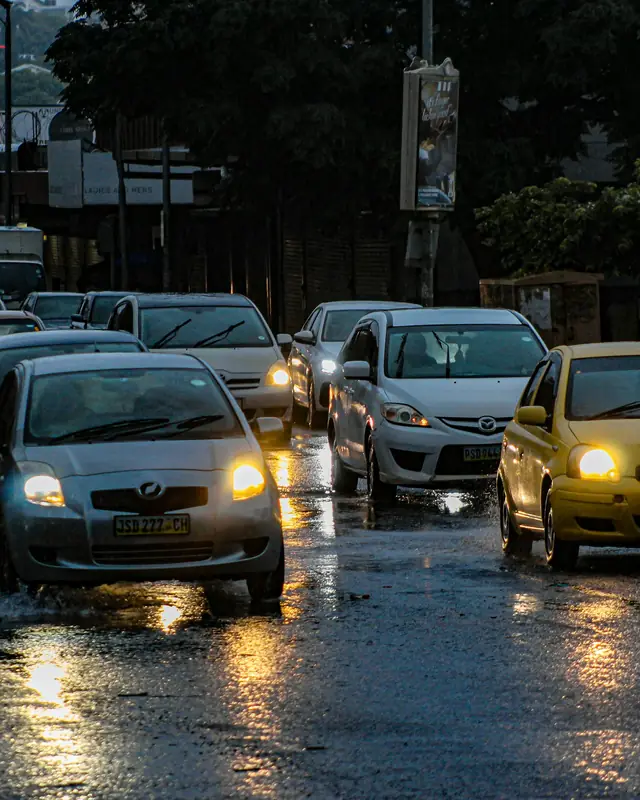
Driving in the First Rain: Why the Roads Get So Slick and What to Do
Photo: proudlyswazi on Unsplash
On this page
The short answer
The first rain after a long dry spell is the slickest because months of oil, grease and dust are still on the pavement, and the water lifts it into a slippery film. Slow down at the first drops, leave more room, turn on your headlights and skip cruise control. Worn tires make all of it worse, so check your tread and pressure before the next storm.
After months without rain, the first storm of the season catches a lot of drivers off guard. The road looks only damp, yet the car feels loose in a turn and takes longer to stop. Here's why the first rain is the slickest, how to drive it, and what to check on your car before the next one.
Why are roads so slippery when it first rains?
Because the road is dirty, not just wet. Over a dry summer, oil, grease, rubber and dust build up on the pavement. When the first rain hits, the water mixes with all of it and leaves a slippery film on top of the asphalt. Caltrans describes it as dirt, oil, grease and grime that accumulated all summer, leaving roads "incredibly slippery."
The California DMV says to slow down at the first sign of rain, especially after a long dry, hot spell, because the oil and dust on the road haven't been washed away yet. A steady rain eventually rinses much of it off, but a light drizzle often just stirs it up, so the first light rain can be slicker than it looks.
Around the valley, you'll feel it most where traffic stops and starts and where oil drips collect: intersections, freeway on-ramps, the stop-and-go on I-15 and Railroad Canyon Road, and parking lots. Painted lines and metal plates get slick too.
How should you drive on wet roads?
Slow down, leave more room, and make every input smooth. The DMV handbook says to reduce your speed by 5 to 10 mph on a wet road. AAA adds that your speed should match how much water is on the road, so go slower where it's pooling.
A short list for the first storm:
- Slow down early. Brake sooner and more gently for stops and turns.
- Leave extra space. Caltrans and AAA both say to increase your following distance.
- Headlights on. The DMV says to use your low beams when it's raining. It helps other drivers see you as much as it helps you see.
- Skip cruise control. AAA says it can increase the chance of losing control on wet roads, because it's harder to ease off quickly when the tires start to slip.
- Follow the tracks. AAA suggests driving in the tracks of the car ahead, where some of the water has already been pushed aside.
- Stay out of standing water when you can. Puddles hide depth, and deeper water makes hydroplaning more likely.
If your car has anti-lock brakes (most newer cars do; your owner's manual will say), press the pedal firmly in a hard stop and let the system pulse. Don't pump it.
What is hydroplaning, and what do you do if it happens?
Hydroplaning is when your tires ride on a layer of water instead of the road. The DMV defines it as a vehicle riding on water because the tires lose all contact with the road. It can feel like the steering suddenly goes light, or the engine revs up without the car speeding up.
It takes less water and less speed than most people think. AAA notes that with as little as 1/12 inch of water on the road, each tire has to push away about a gallon of water per second to keep its grip, and that even new tires can lose some contact at speeds as low as 35 mph.
If it happens:
- Take your foot off the gas slowly.
- Hold the wheel steady and point it where you want to go. Make small corrections, not big ones.
- Don't brake hard. The DMV says sudden braking may cause you to lose control.
- Once you feel the tires grip again, slow down more than you were before.
If the car starts to skid instead, the DMV's steps are to ease off the accelerator, stay off the brakes, steer in the direction of the skid, and try to get a wheel onto dry pavement.
How much do worn tires matter in the rain?
A lot. Tread is what channels water out from under the tire. With less of it, the tire can't clear water as fast and starts to float sooner.
In AAA's testing, tires worn to 4/32 of an inch increased average stopping distance on wet roads by 43 percent, an extra 87 feet at highway speeds, compared to new tires. AAA recommends replacing tires once tread reaches 4/32 of an inch. NHTSA says tires are unsafe and should be replaced at 2/32 of an inch. Most tires also have raised wear bars in the grooves; when the tread is level with them, it's time.
Two quick checks you can do in the driveway:
| Check | How to do it | What it tells you |
|---|---|---|
| Quarter test | Put a quarter upside down in a groove. If you can see all of Washington's head, AAA says to start shopping for tires. That's roughly 4/32 of an inch. | Time to plan for new tires |
| Penny test | Put a penny upside down in a groove. If you can see the top of Lincoln's head, replace your tires (NHTSA). That's roughly 2/32 of an inch. | Replace the tires now |
| Tire pressure | Use a gauge when the car hasn't been driven for at least three hours. | Compare to the sticker in the driver's door jamb |
Check a few spots on each tire, inside and outside edges too. If one edge is much more worn than the rest, that usually points to alignment or pressure, and those tires will lose grip in the rain sooner than the tread in the middle suggests. Our tire safety checklist goes through pressure, tread and tire age in more detail.
What should you check before the first storm?
Most of what helps in the rain you can check yourself in a few minutes:
- Wiper blades. If they streak, chatter or leave a smeared arc, replace them. Months of sun on the dashboard and windshield bake the rubber. Caltrans' rain tips include making sure your wipers are in good condition.
- Washer fluid. Wet roads throw up a gritty spray that smears across the glass.
- Lights. Walk around the car with the headlights, brake lights and turn signals on. Our post on checking your headlights and wipers covers this, plus the California headlight rule.
- Defroster. Turn it on and see how fast it clears the glass. On many cars the defroster uses the A/C to dry the air, so if your A/C is blowing warm, the windows may fog up and clear slowly in the rain.
- Tires. Tread and pressure, as above.
If you're planning a drive to the mountains once the weather turns colder, our winter car prep guide covers chains and the rest.
When to bring it in
Bring the car in if the tread is near 4/32 of an inch or worn more on one edge, if the car pulls to one side or the steering wheel shakes, if the brakes feel soft, grab, or make noise, or if the car felt unsettled in the rain in a way it didn't before.
Here's what we'd look at, in order:
- Tread depth and wear pattern on all four tires, plus pressure and the tires' age.
- Alignment, if the wear is uneven or the car pulls.
- Brakes: pads, rotors and how evenly they stop the car.
- Suspension parts that affect how the tires stay on the road, like shocks, struts and tie rods.
You get a written estimate before we do any work, and repairs come with our 1-year/12,000-mile warranty. See our tires and wheels services or wheel alignment, or call (951) 445-8055.
Recent work like this at our shop
A few recent jobs from our service records. Vehicle, mileage and month only; no customer details.
| Vehicle | Work | Mileage | When |
|---|---|---|---|
| 2015 Ford F-150 | Tire rotation | 80,684 mi | Jul 2026 |
| 2019 Infiniti QX50 | Wheel alignment | 127,052 mi | May 2026 |
| 2014 Toyota Camry | Tire rotation | 125,143 mi | Apr 2026 |
| 2010 Mazda 3 | Tire rotation | 250,149 mi | Mar 2026 |
| 2016 Toyota Camry | Tire rotation | 192,017 mi | Feb 2026 |
Common questions
Why are roads more slippery when it first starts to rain?
Over a dry summer, oil, grease, rubber and dust build up on the pavement. The California DMV says roads are especially slick after a long dry, hot spell because that oil and dust haven't been washed away yet. Rain mixes with it and makes a slippery film until enough water rinses it off.
How much should I slow down on wet roads?
The California Driver Handbook says to reduce your speed by 5 to 10 mph on a wet road. AAA adds that your speed should match how much water is on the road, so slow down more where water is pooling.
What should I do if my car hydroplanes?
Ease off the gas, keep the steering wheel straight or make only small corrections, and don't brake hard. The DMV says to slow down gradually and not use the brakes, because sudden braking can make you lose control. Once the tires grip again, slow down further.
Do I have to turn on my headlights when it rains in California?
California Vehicle Code section 24400 requires headlights in inclement weather, and it counts conditions that need your wipers running continuously as inclement weather. The DMV handbook says to use your low beams when it's raining. Our headlights and wipers post covers the details.
Is it safe to use cruise control in the rain?
It's better not to. AAA says using cruise control on wet roads can increase the chance of losing control, because it's harder to ease off the gas quickly when the tires start to lose grip.
Sources
- California DMV, California Driver Handbook, Section 8 Safe Driving
- Caltrans, Motorists Should Prepare for Rain-slick Valley Roadways
- AAA, Wet Weather Driving Tips
- {'AAA Newsroom, Tread Lightly': 'Worn Tires Put Drivers at Risk | https://newsroom.aaa.com/2018/06/tread-lightly-worn-tires-drivers-risk/'}
- National Highway Traffic Safety Administration, Tires
- California Vehicle Code section 24400
More from the blog
Getting Your Car Ready for a Southern California Winter
Winter here means rain, cold mornings and trips to the snow. What to check on your battery, tires, wipers and coolant, plus Caltrans chain rules for Big Bear.
Why Are My Headlights Foggy, and How Do You Fix Them?
What turns plastic headlights cloudy and yellow, how much light you lose, whether restoration kits work, and when a new headlight is the better answer.
Do You Need to Warm Up Your Car Before Driving?
Most modern cars need about 30 seconds, not five minutes. Why long idling wastes fuel, what actually protects your engine on a cold morning, and when to worry.