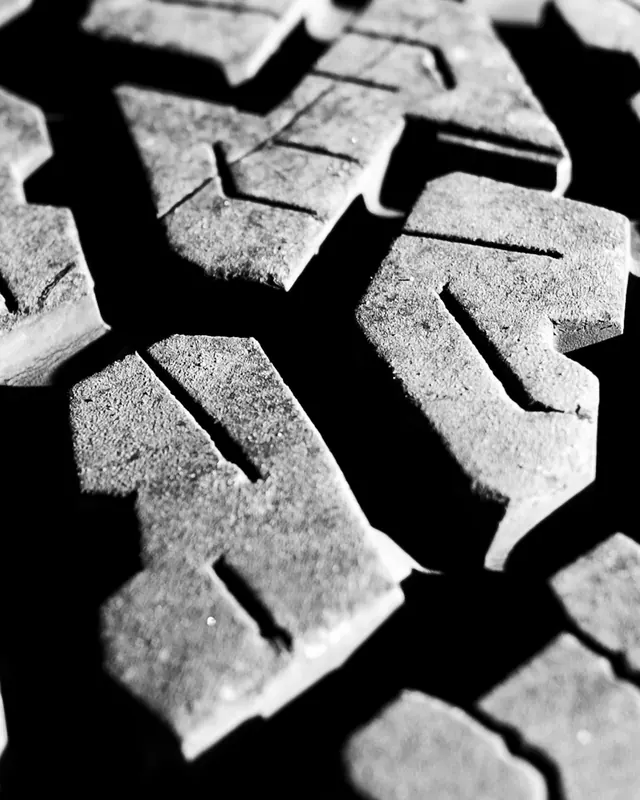
A Mechanic's Tire Safety Checklist (Pressure, Tread and Age)
Photo: Marvin Sagisi on Unsplash
On this page
The short answer
Once a month, check all four tires and the spare with a gauge when they're cold, using the pressure on the driver's door sticker, not the number on the tire. Replace tires when tread reaches 2/32 of an inch (the penny test), when the sidewall is cracked or bulging, or when they reach the age your vehicle or tire maker recommends (often six to ten years).
Tires are the only part of the car that touches the road, and they wear out quietly. Most tire problems we see could have been caught in a two-minute check in the driveway. This is the checklist we'd give a friend, in the order we'd do it.
How often should you check tire pressure?
Once a month and before any long trip, according to NHTSA. Check all four tires and the spare, and do it when the tires are cold, meaning the car hasn't been driven for a few hours. Driving warms the air inside and gives you a higher reading.
How to do it:
- Find the right number on the sticker on the driver's door edge or door pillar. Don't use the number molded into the tire; that's the maximum the tire can hold.
- Press a tire gauge firmly onto the valve stem and read it.
- Add air to bring it up to the sticker pressure. If you overshoot, press the pin in the valve to let a little out.
- Put the valve caps back on. They keep dirt and moisture out of the valve.
Pressure changes with temperature, about one psi for every 10 degrees. A tire set on a 95-degree afternoon in September can read several psi low on the first cold morning in November, which is why tire pressure lights pop on this time of year.
Why low pressure is a bigger deal than it looks
An underinflated tire flexes more, runs hotter and wears out the outer edges. On a hot freeway in the Inland Empire, with pavement temperatures well above the air temperature, that extra heat is how tread separations and blowouts start. Low pressure also makes the car feel vague in turns and costs fuel.
Your tire pressure monitoring light only comes on when a tire is significantly low, so NHTSA is clear that it doesn't replace a monthly check.
How do you check tire tread with a penny?
Tires are worn out at 2/32 of an inch of tread. To check without a gauge:
- Put a penny into a tread groove with Lincoln's head upside down and facing you.
- If you can see the top of Lincoln's head, the tread is at or below 2/32 and the tire should be replaced.
- Check several spots on each tire, inner, center and outer grooves, because tires don't always wear evenly.
Tires also have built-in wear bars, small raised bridges across the bottom of the grooves. When the tread is level with them, the tire is done.
Grip in the rain drops off well before 2/32. If you drive a lot on wet roads or up to the mountains in winter, consider replacing tires sooner, around 4/32. A quarter works the same way as the penny: if you can see all of Washington's head, you're at or below 4/32.
What causes uneven tire wear?
Uneven wear usually points to something else that needs attention:
| Wear pattern | Likely cause |
|---|---|
| Both outer edges worn | Underinflation |
| Center worn | Overinflation |
| One edge worn (inner or outer) | Alignment out of spec |
| Scalloped or cupped patches | Worn shocks or struts, or out of balance |
| Flat spots | Hard braking or a locked-up brake |
If you see any of these, new tires alone won't fix it. The cause needs to be corrected or the new set will wear the same way. An alignment check or suspension inspection usually finds it.
How old are your tires?
Rubber ages even if the tread looks good, especially in heat and sun. NHTSA notes that some vehicle and tire makers recommend replacing tires six to ten years after they were made, regardless of tread.
To find the age, look for the DOT code on the sidewall. The last four digits are the week and year of manufacture: 3221 means the 32nd week of 2021. It may only be printed on one side, so check both.
Also look for:
- Cracks in the sidewall or between the tread blocks
- Bulges or bubbles on the sidewall, which mean internal damage. Replace that tire now.
- Nails, screws or cuts, and slow leaks that need air every week
Rotation, balance and the spare
- Rotate every 5,000 to 7,500 miles or as your manual says. Front tires wear faster on most cars.
- Balance if you feel a vibration in the steering wheel at highway speed.
- Check the spare. It loses air sitting in the trunk, and a flat spare is no help on the side of the 15.
When to bring it in
Bring it in if a tire keeps losing air, has a bulge, is at 2/32 or below, or is wearing unevenly. We'll check pressure, tread and age on all four plus the spare, look at tires and wheels, balance and alignment, and give you a written estimate before any work starts.
Recent work like this at our shop
A few recent jobs from our service records. Vehicle, mileage and month only; no customer details.
| Vehicle | Work | Mileage | When |
|---|---|---|---|
| 2015 Ford F-150 | Tire rotation | 80,684 mi | Jul 2026 |
| 2019 Infiniti QX50 | Wheel alignment | 127,052 mi | May 2026 |
| 2014 Toyota Camry | Tire rotation | 125,143 mi | Apr 2026 |
| 2010 Mazda 3 | Tire rotation | 250,149 mi | Mar 2026 |
| 2016 Toyota Camry | Tire rotation | 192,017 mi | Feb 2026 |
Common questions
Where do I find the right tire pressure for my car?
On the Tire and Loading Information label, usually on the driver's door edge or door pillar, or in the owner's manual. The number molded into the tire sidewall is the maximum the tire can hold, not what your car needs.
Why does my tire pressure light come on when it gets cold?
Air pressure drops as the temperature drops, roughly one psi for every 10 degrees. A tire that was borderline on a warm afternoon can trip the light on a cold morning. Fill it to the door sticker pressure when the tires are cold.
How do I know how old my tires are?
Find the DOT code on the sidewall. The last four digits are the week and year the tire was made, so 3221 means the 32nd week of 2021. It may only be on one side of the tire.
How often should tires be rotated?
Most owner's manuals call for a rotation every 5,000 to 7,500 miles, which lines up with many oil change intervals. Rotation evens out wear between the front and rear tires so the set lasts longer.
Sources
More from the blog
How Often Should You Change Your Oil? (It's Probably Not 3,000 Miles)
The 3,000-mile rule is out of date for most cars. How to find your real oil change interval, when the severe schedule applies and why the once-a-year rule matters.
Car Overheating? What to Do Right Away (and What Not to Do)
Temperature gauge climbing or steam from the hood? What to do in the first minute, why the heater helps, why not to open a hot radiator cap and when to tow it.
Why Do My Brakes Squeak? What Each Brake Noise Means
Squealing, grinding, clicking or scraping when you brake? What each noise usually means, which can wait and which mean stop driving, from our Lake Elsinore shop.