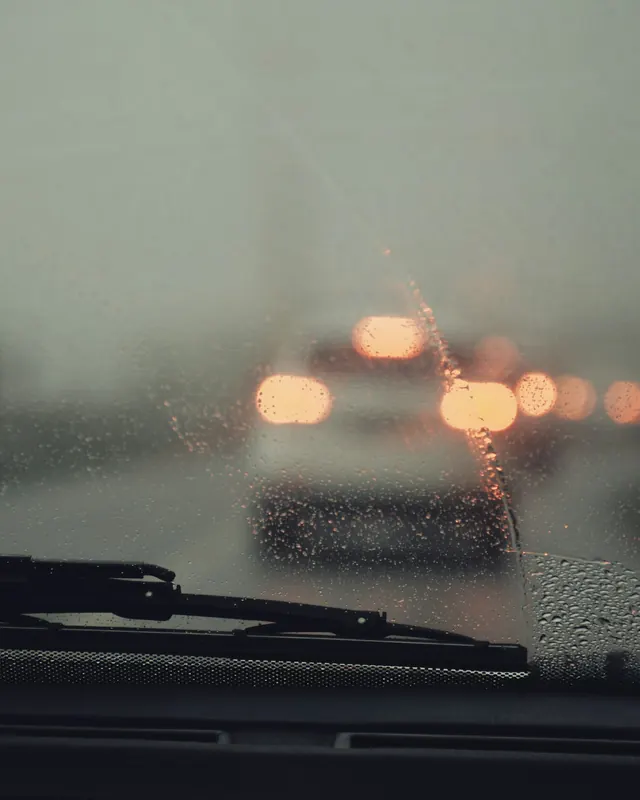
Days Are Getting Shorter. Check Your Headlights and Wipers Now
Photo: Hossein Soltanloo on Unsplash
On this page
- The short answer
- Why check your lights when daylight saving time ends?
- How do I check if all my car lights work?
- How often should you replace wiper blades?
- Is it the law to use headlights in the rain in California?
- Why are my headlights so dim?
- When a light problem is more than a bulb
- When to bring it in
- Recent work like this
- Common questions
The short answer
Walk around your car with the lights on once a month: headlights on low and high beam, brake lights, turn signals and the license plate light. Replace wiper blades every 6 to 12 months, sooner if they streak or chatter. In California, if your wipers are on because of rain, your headlights have to be on too.
Daylight saving time ends on Sunday, November 1. That week the evening commute home from Temecula or Corona suddenly happens in the dark, and the first real rain usually isn't far behind. It's a good time to spend five minutes on the two things that let you see and be seen: your lights and your wipers.
Why check your lights when daylight saving time ends?
A lot more of everyone's driving happens in the dark once the clocks change, and night driving is where weak lights hurt most. Add the first rain after a long dry summer, when roads are slick with built-up oil, and you want every light working and a windshield you can actually see through.
How do I check if all my car lights work?
The Car Care Council's advice is simple: check your lights from outside the car, because you can't see most of them from the driver's seat. Do it in a garage or at dusk so the lights are easy to see.
- Headlights, low beam and high beam.
- Turn signals, front and rear on both sides. A signal that blinks fast usually means a bulb is out on that side.
- Brake lights, including the third light up high. Back up close to a wall or garage door and watch the reflection, or ask someone to stand behind the car.
- Taillights and parking lights.
- Reverse lights and the license plate light.
- Fog lights, if your car has them.
Look at the color and brightness while you're there. One headlight noticeably dimmer or yellower than the other usually means the bulb is near the end.
How often should you replace wiper blades?
AAA recommends replacing wiper blades every 6 to 12 months. In the Inland Empire the sun does more damage than the rain. A summer of 100-degree days bakes the rubber edge until it's stiff and cracked, and you don't find out until the first storm.
Replace them if you see any of these:
- Streaks or smears across the glass, the most common sign.
- Missed patches, usually where the blade frame is bent.
- Chattering or skipping as the blade crosses the windshield.
- Cracked, split or hardened rubber when you run a finger along the edge.
Don't forget the rear wiper on an SUV or hatchback, and top off the washer fluid. Plain water leaves streaks and doesn't cut road film.
Is it the law to use headlights in the rain in California?
Yes. California Vehicle Code section 24400 requires headlights during darkness and in "inclement weather," which the law defines to include any time your windshield wipers are in continuous use because of rain, mist, snow or fog. It also covers conditions where you can't see a person or vehicle 1,000 feet away.
Daytime running lights aren't enough. On most cars they don't turn on the taillights, so the driver behind you can't see you in spray. Turn the switch to on, or to auto if your car has it, whenever the wipers are going.
Why are my headlights so dim?
Two things make working headlights perform badly:
- Aim. Headlights knocked low by a pothole or a past repair shorten how far you can see. Aimed too high, they blind oncoming drivers. If your low beams light up the road just a few car lengths ahead, have the aim checked.
- Cloudy lenses. Plastic headlight covers yellow and haze with sun exposure. Badly clouded lenses block most of the light; we cover how much, and what to do about it, in why headlights get foggy.
When a light problem is more than a bulb
Some light problems are electrical rather than a burned-out bulb:
- A new bulb doesn't light, or works only when you hit a bump.
- Several lights go out at once.
- Lights flicker, or brighten and dim with engine speed. That can point to the charging system.
- A dashboard bulb-out warning stays on after the bulb is replaced.
We trace those with a meter: a fuse, a corroded connector, a broken ground wire, or sometimes the alternator. Our diagnostic service finds the cause before anything gets replaced.
When to bring it in
If a bulb is out and you're not comfortable swapping it (some cars need the bumper or a wheel liner moved to reach it), bring it in. Same if the washer doesn't spray or your lights flicker or keep burning out. We'll check the bulbs, the washer pump and the wiring, and tell you what needs fixing before we touch anything.
Recent work like this at our shop
A few recent jobs from our service records. Vehicle, mileage and month only; no customer details.
| Vehicle | Work | Mileage | When |
|---|---|---|---|
| 2015 Honda Accord | Headlight bulb | 241,127 mi | Jun 2023 |
| 2015 Chevrolet Silverado 1500 | Washer pump | 61,159 mi | Jun 2023 |
Common questions
How often should I replace my wiper blades?
AAA recommends every 6 to 12 months. Here, sun is the bigger enemy than rain. The rubber dries out and cracks over a hot summer, so replace them in the fall before the first storm rather than waiting until you need them.
Do I have to turn my headlights on when it rains in California?
Yes. California Vehicle Code section 24400 requires headlights in darkness and in "inclement weather," which includes any time your wipers are in continuous use because of rain, mist or fog. Daytime running lights usually don't turn on the taillights, so switch the headlights on.
Why is only one headlight out?
Bulbs rarely fail at the same time, so one going first is normal. Replace them in pairs anyway; the old one is usually close behind and the two will match in color and brightness. If the new bulb doesn't fix it, the problem is a fuse, connector or wiring.
Why are my headlights dim even with new bulbs?
Usually the plastic lenses have gone cloudy or yellow, or the headlights are aimed too low. Both cut how far you can see at night. Our post on foggy headlights covers what to do about the lenses.
Sources
More from the blog
Getting Your Car Ready for a Southern California Winter
Winter here means rain, cold mornings and trips to the snow. What to check on your battery, tires, wipers and coolant, plus Caltrans chain rules for Big Bear.
Why Are My Headlights Foggy, and How Do You Fix Them?
What turns plastic headlights cloudy and yellow, how much light you lose, whether restoration kits work, and when a new headlight is the better answer.
Do You Need to Warm Up Your Car Before Driving?
Most modern cars need about 30 seconds, not five minutes. Why long idling wastes fuel, what actually protects your engine on a cold morning, and when to worry.