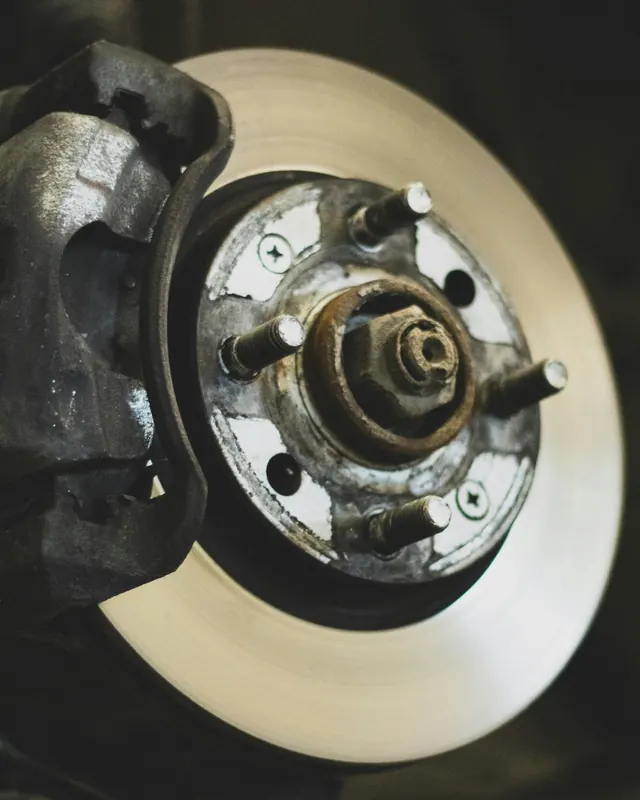
How Long Do Brake Pads Last? Real Mileage Ranges and How to Check Yours
Photo: Benjamin Brunner on Unsplash
On this page
- The short answer
- How many miles do brake pads last?
- Why do some brake pads wear out faster?
- Do front brake pads wear faster than rear pads?
- How thin is too thin for brake pads?
- What does the brake wear indicator sound like?
- How can I check my brake pads myself?
- When to bring it in
- Recent work like this
- Common questions
The short answer
Most brake pads last somewhere between 25,000 and 70,000 miles, and the range is that wide because driving matters more than the calendar. Stop-and-go traffic, hills, heavy loads and hard stops wear pads faster. Go by measurement, not mileage: AAA says pads under about 1/4 inch are likely due, and the wear indicator squeal means they're close to the end.
You had your oil changed and someone mentioned your brake pads, or you're just wondering how much longer the ones on your car have left. There's no single mileage that fits every car. Here's the realistic range, what makes pads wear faster around here, how thin is too thin, and how to tell where yours are without guessing.
How many miles do brake pads last?
Most brake pads last between about 25,000 and 70,000 miles, depending on the car and how it's driven. The published numbers vary because the sources measure different things:
| Source | What it says |
|---|---|
| AAA | On average, brakes should be replaced about every 30,000 miles, depending on the vehicle, driving habits and weather |
| AAA (Auto Club Group) | Most pads last between 25,000 and 70,000 miles, depending on driving habits |
| Chevrolet | 40,000 to 60,000 miles of pad life in average use; 20,000 to 25,000 miles in very severe use |
So a pad that's done at 28,000 miles isn't necessarily defective, and one still going at 60,000 isn't unusual. What the pad measures today is what counts.
Why do some brake pads wear out faster?
Brake pads wear fastest on cars that stop often, stop hard or carry weight down hills. Chevrolet lists the conditions that shorten pad life: frequent heavy braking, high temperatures from high-speed braking or mountain driving, driving heavily loaded, and areas with a lot of road debris and dust. AAA adds that stop-and-go traffic shortens brake life too.
Plenty of driving around Lake Elsinore checks those boxes:
- Stop-and-go traffic on I-15 and Railroad Canyon Road at rush hour means a lot of stops per mile.
- Long grades like Ortega Highway (SR-74) heat the pads up, especially if you ride the pedal on the way down.
- Towing or hauling a trailer, a boat to the lake or a full load for a weekend trip adds weight the brakes have to stop.
- Dust and grit from windy days and dirt roads, which Chevrolet lists among the conditions that shorten pad life.
Your habits count as much as the roads. Coasting up to a red light instead of braking late, and using a lower gear on long downhills, both take load off the pads.
Do front brake pads wear faster than rear pads?
Front brake pads usually wear out first. When you stop, the car's weight shifts forward, so the front brakes do most of the work. On cars with drum brakes in back, the rears use shoes instead of pads and are checked separately.
That's why it's normal to replace front pads once or twice before the rears need anything. It's also why a quote for "brakes" may only cover one axle. Pads are replaced as a pair on the same axle: Kia's owner's manual says to always replace front or rear pads as pairs, so both sides grip evenly.
If one wheel's pads are much thinner than the other side, that isn't normal wear. A sticking caliper or a dry slide pin can keep one pad dragging on the rotor.
How thin is too thin for brake pads?
AAA says that if pad thickness is less than about 1/4 inch (roughly 6 mm), you'll likely need to replace them. That's a sensible point to start planning. The hard limit is lower:
- Chevrolet sets its wear indicators to make noise at around 2 mm of friction material and says pads should be replaced at or before 2 mm.
- AAA (Auto Club Group) says pads under an eighth of an inch (about 3 mm) should be replaced.
Your car's service information lists the exact minimum. Whenever your pads are measured, ask for the actual number, not just "they're fine," so you can see how fast they're wearing from one visit to the next.
What does the brake wear indicator sound like?
Most wear indicators make a high-pitched squeal or chirp once the pads are nearly worn out. On many cars it's a small metal tab on the pad that touches the rotor on purpose. Kia's manual says you may hear the sound come and go, or hear it every time you press the brake pedal. Chevrolet notes it may be there with or without the pedal pressed.
Some cars use an electronic sensor that turns on a warning light instead. Either way, it's a warning, not a failure, but don't let it go for months. Kia's manual says not to keep driving with worn brake pads and warns that it can damage the braking system. The part that usually suffers is the rotor: past the indicator, the metal backing plate grinds into the rotor, and a pad job turns into pads and rotors.
Not every squeak is the indicator. A squeak on the first few stops on a damp morning is usually moisture on the rotors. Our guide to what each brake noise means sorts them out.
How can I check my brake pads myself?
On many cars with open-spoke wheels, you can see the outer pad without taking anything apart. Park on level ground, turn the front wheels all the way to one side and look through the wheel at the caliper. The pad is the block pressed against the rotor; you're looking at how thick the friction material is compared with its metal backing.
A few limits to keep in mind:
- You can only see the outer pad. The inner pad often wears faster, and it's hidden behind the rotor.
- Some wheels hide the caliper completely. Then the wheel has to come off.
- Don't touch anything after a drive. Brakes get hot enough to burn.
Things you can notice from the driver's seat count too: a squeal that won't go away, grinding, a pedal that feels different, or the car pulling to one side when you stop. A pulsing pedal or steering wheel shake is usually the rotors; see why a car shakes when braking.
When to bring it in
Have the pads measured at least once a year, and any time you hear or feel something new. AAA suggests checking the brakes each time the tires are rotated, and the Auto Club Group recommends an inspection at every oil change or at least every 12,000 miles. More on timing is in how often to get your brakes checked.
Come in right away if you hear grinding, the pedal feels soft or sinks, or the red brake light stays on with the parking brake off.
At our shop, a brake inspection means taking the wheels off and checking:
- Inner and outer pad thickness on every wheel
- Rotor condition and thickness, against the minimum stamped on the rotor
- Calipers and slide pins for sticking or uneven wear
- Brake hoses, lines and fluid
You get the measurements and a written estimate before any work, with what needs doing now and what can wait. Our ASE-certified technicians stand behind brake repairs with a 1-year/12,000-mile warranty. Call (951) 445-8055 or book a time online.
Recent work like this at our shop
A few recent jobs from our service records. Vehicle, mileage and month only; no customer details.
| Vehicle | Work | Mileage | When |
|---|---|---|---|
| 2023 Ford Edge | Brake pads | 124,143 mi | Sep 2026 |
| 2009 Toyota Camry | Brake inspection | 107,679 mi | Jun 2026 |
| 2025 Volkswagen Jetta | Brake inspection, Brake pads | 33,897 mi | Apr 2026 |
| 2010 Mazda 3 | Brake pads | 250,149 mi | Mar 2026 |
| 2013 Toyota Tundra | Brake inspection, Brake pads, Front brake rotors | 138,321 mi | Mar 2026 |
Common questions
How many miles do front brake pads last?
Front pads usually land somewhere in the general range AAA's Auto Club Group gives for pads, about 25,000 to 70,000 miles. The front brakes do most of the work when you stop, so they usually wear out before the rears. Your driving and your car decide where in that range you land.
How thin is too thin for brake pads?
AAA says that if pad thickness is less than about 1/4 inch, you'll likely need to replace them. Chevrolet sets its wear indicators to make noise at around 2 mm of pad material and says to replace pads at or before 2 mm. Your car's service information lists the exact minimum.
Do I have to replace all four brake pads at once?
No. Pads are replaced per axle, front pair or rear pair, so both sides of an axle stop evenly. Fronts and rears often wear at different rates, so one axle may be due long before the other.
Can I drive with the brake wear indicator squealing?
Plan the repair now. The squeal means the pads are nearly worn out, and Kia's manual says not to continue driving with worn brake pads. Once pads wear past the indicator, the metal backing plate can start cutting into the rotors.
Why did my brake pads wear out so fast?
The usual reasons are lots of stop-and-go driving, steep hills, carrying heavy loads, hard braking and riding the pedal. A sticking caliper or slide pin can also make one pad wear much faster than the others, which is worth having checked if one side wore out first.
Sources
More from the blog
Why Does My Car Shake When I Brake? Rotors, Pads and Other Causes
Steering wheel shakes or the brake pedal pulses when you stop? What usually causes it, why "warped rotors" isn't the whole story, and when it's not safe to drive.
How Often Should You Change Brake Fluid? What the Manuals Say and How to Tell
How often to change brake fluid, why it absorbs water, what a soft pedal on a long downhill means, and how a shop tests old fluid. From our Lake Elsinore shop.
Why Do My Brakes Squeak? What Each Brake Noise Means
Squealing, grinding, clicking or scraping when you brake? What each noise usually means, which can wait and which mean stop driving, from our Lake Elsinore shop.