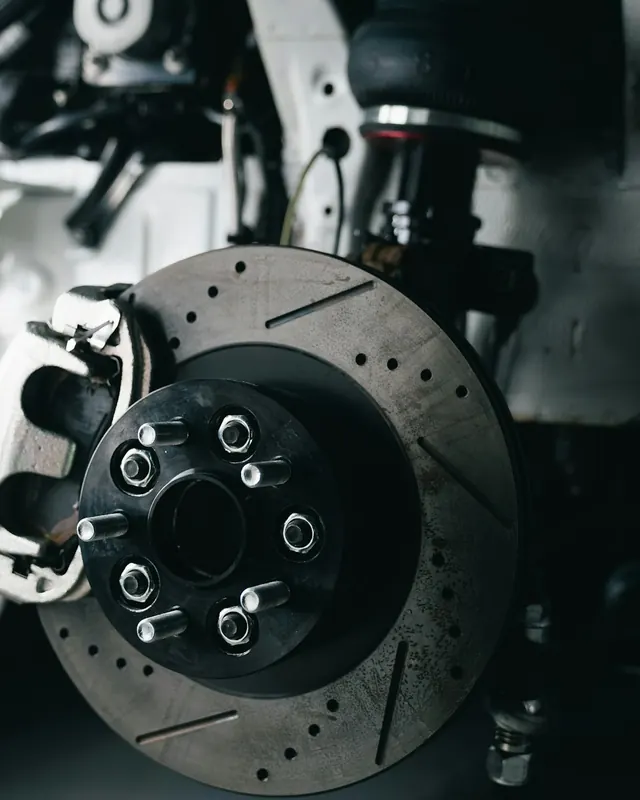
Why Does My Car Shake When I Brake? Rotors, Pads and Other Causes
Photo: Erik Mclean on Unsplash
On this page
- The short answer
- Why does my car shake when I brake?
- Are my rotors actually warped?
- Steering wheel shake or pedal pulse: front or rear brakes?
- Why is it worse going downhill?
- Is it safe to drive with a car that shakes when braking?
- What can I check myself?
- When to bring it in
- Recent work like this
- Common questions
The short answer
A car that shakes or a brake pedal that pulses when you stop is most often caused by a front brake rotor that's no longer the same thickness all the way around, usually from uneven wear or pad material building up on it. People call this warped rotors. Runout from uneven lug nut torque or rust on the hub, a worn wheel bearing or worn suspension parts can cause it too. It's rarely an emergency, but have it checked soon.
You press the brake coming off the 15 at Railroad Canyon and the steering wheel wiggles in your hands, or the pedal pushes back against your foot in a steady pulse. The car still stops, but it doesn't feel right. Here's what usually causes it, why "warped rotors" is only part of the answer, what you can check yourself and when it's not safe to keep driving.
Why does my car shake when I brake?
The most common cause is a brake rotor that's no longer the same thickness all the way around. Brake technicians call it disc thickness variation. As the rotor spins through the caliper, the pads squeeze a thick spot, then a thin spot, many times a second. That uneven grip is what you feel as a shake or a pulse.
It doesn't take much. Brake & Front End says thickness variation over 15 microns, well under a thousandth of an inch, can easily lead to driver complaints, and calls pedal pulsation the symptom of excessive thickness variation.
Other causes that feel similar:
- Pad material built up unevenly on the rotor, usually after the brakes got very hot.
- Runout, meaning the rotor wobbles slightly as it turns, from uneven lug nut torque, rust between the rotor and hub, or a bent rotor or hub.
- A sticking caliper or slide pins, which keep a pad dragging on one side and overheats that rotor.
- A worn wheel bearing or suspension parts, which let the wheel move under braking.
Are my rotors actually warped?
Usually not in the way most people picture. Brake & Front End explains that people tend to equate high runout with "warping," but runout by itself isn't what directly makes the brakes rough. Thickness variation is, and pad deposits are a big source of it. The magazine says uneven pad material build-up creates uneven rotor thickness, "which gives you the sensation of a 'warped' brake rotor."
Runout still matters, because it starts the problem. Audi's brake pulsation service bulletin lists prolonged use of a rotor with high runout as one of the causes of thickness variation, along with rust build-up and pad material transfer. A rotor that wobbles a little brushes the pads on every turn, wears unevenly, and over thousands of miles the thick and thin spots appear. Bendix notes thickness variation can show up 10,000 to 15,000 km (about 6,000 to 9,000 miles) after a rotor is machined or replaced.
So "you need rotors" may be right, but the better question is why they wore that way.
Steering wheel shake or pedal pulse: front or rear brakes?
Where you feel it is a useful clue, not a diagnosis.
| What you feel when braking | Usually points to |
|---|---|
| Steering wheel shakes side to side | Front rotors, or front suspension and steering parts |
| Pedal pulses under your foot | Rotor thickness variation, front or rear |
| Seat or floor vibrates more than the wheel | Could be front or rear; often the rear |
| Shake only on long downhill stops | Rotors that pulse more when hot |
| Shake at speed even without braking | Wheels and tires, not brakes |
Bendix lists all three as symptoms of thickness variation: pedal pulsation, a left-to-right steering wheel oscillation and vibration through the floor. If the car also shakes on the freeway with your foot off the brake, start with our post on why a steering wheel shakes at highway speed, since balance and tire problems are more likely.
Why is it worse going downhill?
Heat. Bendix says the effect is magnified as the rotor gets hotter, giving the example of travelling down an incline with the brakes on. Long grades like Ortega Highway (SR-74) heat the front brakes hard, so a pulse you barely notice around town can be obvious on the way down.
Heat is also how many pad deposits start. Brake & Front End says deposits form when pads go beyond their operating temperature limit, and Audi's bulletin warns that overheated brake parts can be permanently damaged. On a long downhill, use a lower gear so the engine does some of the slowing, and brake firmly in bursts rather than riding the pedal. If you smell hot brakes, give them time to cool before you keep going.
Is it safe to drive with a car that shakes when braking?
A mild, steady pulse that has crept in over weeks usually isn't an emergency, but it doesn't fix itself and it tends to get worse as the rotor wears unevenly. Have it checked soon.
Stop driving, or keep your speed low on the way to a shop, if you notice any of these:
- The shake is violent or came on suddenly.
- You hear grinding or scraping when you brake.
- The car pulls hard to one side when braking.
- One wheel smells hot or looks much dirtier with brake dust than the others.
- The pedal feels soft, sinks or travels farther than it used to.
If the pedal is soft or sinks toward the floor, don't drive the car; have it towed. The others point to worn-out pads, a dragging caliper or a brake system problem, not just an uneven rotor. Our post on what each brake noise means covers the grinding and scraping sounds in more detail.
What can I check myself?
A few things are safe to check yourself with the car parked:
- Notice when it happens. Only when braking, or also at steady speed? Light stops, hard stops, or only hot ones? That narrows it down quickly.
- Look at the rotors through the wheel spokes. Dark patches, a blue tint or uneven bands on the shiny surface can mean overheating or deposits.
- Compare wheels after a drive. Carefully hold your hand near (not on) each wheel. One that's much hotter than the others suggests a dragging brake. Don't touch the wheel or rotor, since both can be very hot.
- Think about recent work. New tires, a rotation or a brake job shortly before the shake started is worth mentioning.
Measuring runout and thickness takes a dial indicator and a micrometer with the wheel off, so leave that part to a shop.
When to bring it in
Book a visit if the pedal pulses or the wheel shakes when you brake, especially before a long trip or the drive up to Big Bear. On a brake repair visit, here's what we check, in order:
- A test drive to feel when and where the shake happens.
- Pads, rotors and calipers with the wheels off, including rotor thickness, runout, deposits and heat marks, and whether the caliper slide pins move freely.
- Wheel bearings, tie rods and other steering and suspension parts, since play there can feel like a brake problem.
- A written estimate before any work starts.
If the rotors are the cause, the usual fix is replacing them along with the pads, so the new pads aren't riding on an uneven surface. The hub face should also be cleaned and the lug nuts tightened to spec with a torque wrench, to help keep it from coming back. Our repairs carry a 1-year/12,000-mile warranty. You can call us at (951) 445-8055 or book a visit online.
Recent work like this at our shop
A few recent jobs from our service records. Vehicle, mileage and month only; no customer details.
| Vehicle | Work | Mileage | When |
|---|---|---|---|
| 2023 Ford Edge | Brake pads, Rear brake rotors | 124,143 mi | Sep 2026 |
| 2009 Toyota Camry | Brake inspection | 107,679 mi | Jun 2026 |
| 2025 Volkswagen Jetta | Brake inspection, Brake pads, Rear brake rotors | 33,897 mi | Apr 2026 |
| 2010 Mazda 3 | Brake pads, Rear brake rotors | 250,149 mi | Mar 2026 |
| 2013 Toyota Tundra | Brake inspection, Brake pads, Front brake rotors | 138,321 mi | Mar 2026 |
Common questions
Is it safe to drive if my car shakes when I brake?
A mild pulse in the pedal that's been there a while usually isn't an emergency, but it's worth having checked soon. If the shake is violent, came on suddenly, or comes with grinding, a pull to one side, a burning smell or a pedal that sinks, stop driving it if you can, or keep your speed low on the shortest way to a shop. If the pedal sinks, have it towed.
Are my rotors warped?
Probably not in the bent-like-a-record sense. The usual cause is disc thickness variation: Bendix describes it as uneven wear of the rotor that leaves flat spots or thin sections, and Audi's service bulletin says the rotor's two braking faces are no longer parallel. Uneven pad material on the rotor can feel the same, and Brake & Front End notes this is what gives the sensation of a warped rotor.
Can new brake pads fix a car that shakes when braking?
Usually not by themselves. If the rotor has uneven thickness or heavy deposits, new pads will ride over the same high and low spots and the pulse comes back. The rotor normally gets resurfaced or replaced at the same time, and the cause (lug nut torque, a sticking caliper, rust on the hub) gets corrected too.
Why does my car only shake when braking downhill?
Heat makes it worse. Bendix notes that the effect of disc thickness variation is magnified as the rotor gets hotter, for example after going down an incline with the brakes on. A long grade heats the rotors, so a pulse you barely feel around town can show up clearly on the way down.
Why did my brakes start shaking after new tires?
One likely reason is uneven lug nut torque. Brake & Front End says under-torquing a single lug nut can create as much as 0.003 inch of lateral runout in a rotor, and Audi's brake bulletin warns that over-torqued or improperly torqued wheels, including from an impact gun, can distort the rotor and hub. Having the lug nuts checked with a torque wrench is a quick first step.
Sources
More from the blog
How Often Should You Change Brake Fluid? What the Manuals Say and How to Tell
How often to change brake fluid, why it absorbs water, what a soft pedal on a long downhill means, and how a shop tests old fluid. From our Lake Elsinore shop.
Why Do My Brakes Squeak? What Each Brake Noise Means
Squealing, grinding, clicking or scraping when you brake? What each noise usually means, which can wait and which mean stop driving, from our Lake Elsinore shop.
How Often Should You Get Your Brakes Checked?
How often to have your brakes checked, the warning signs that can't wait, and what a brake inspection actually covers, from our Lake Elsinore mechanics.