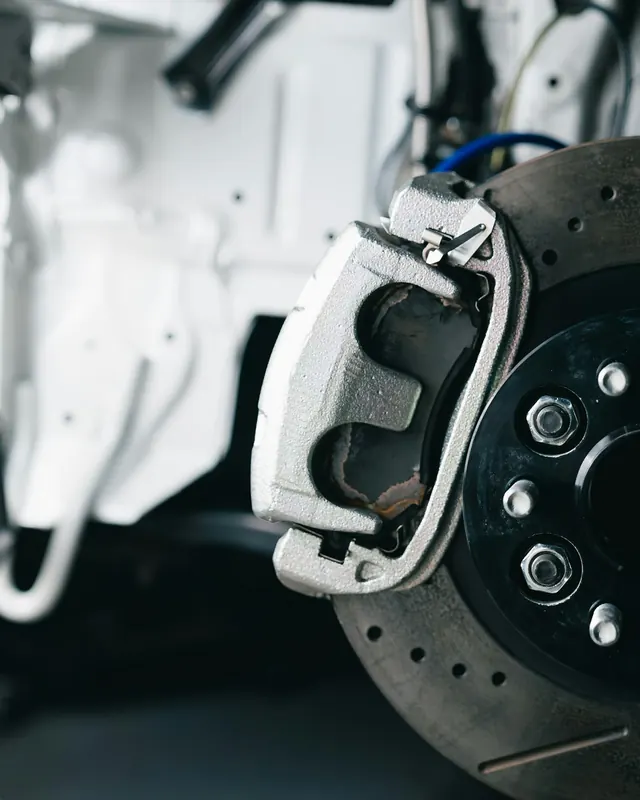
How Often Should You Get Your Brakes Checked?
Photo: Erik Mclean on Unsplash
On this page
The short answer
Have your brakes looked at once a year, and any time you hear grinding, feel the pedal go soft or the car pulls when you stop. Pads are the part that wears out; catching them before they reach the rotors is the difference between a routine pad job and replacing rotors too.
Brakes are the one system nobody wants to guess about. The trouble is that they wear out slowly, so a car can feel fine right up until the pads are gone. So it helps to know how often to have them checked, what to watch for in between, and what we actually look at when your car is on the lift.
How often should you get your brakes checked?
Once a year is the simple answer, and it's what the Car Care Council recommends even if you don't notice anything wrong. A lot of drivers line it up with an oil change or a tire rotation, since the wheels are coming off anyway.
Check sooner if you drive in conditions that are hard on brakes:
- Daily stop-and-go on I-15 or Railroad Canyon Road
- Hills and long downgrades, like Ortega Highway (SR-74) down to the lake
- Towing a trailer or boat, or a truck that's usually loaded
- Rideshare or delivery driving with lots of short trips
Those cars wear pads noticeably faster than one that mostly cruises on the freeway.
What are the warning signs of bad brakes?
Your brakes usually tell you before they fail. These are the signs we take seriously:
- Grinding or a metal-on-metal scrape. The pad material is gone and the backing plate is hitting the rotor. Get it in right away; every mile now is chewing up the rotor.
- A high-pitched squeal that doesn't go away. Many pads have a small metal tab that squeals when they're getting thin. It's a heads-up, not an emergency, but don't let it ride for months.
- A soft or sinking pedal. This points to air or a leak in the hydraulic system, or worn fluid. That one is a "stop driving it" sign.
- Pulling to one side when you brake. Often a sticking caliper or a collapsed brake hose.
- A pulsing pedal or shaking steering wheel when you stop. Usually uneven rotor wear.
- The red brake light stays on after you've released the parking brake.
What's included in a brake inspection?
When we inspect brakes we pull the wheels and look at the whole system, not just the pads:
- Pad thickness, inside and outside on each wheel. The inner pad often wears faster and you can't see it through the wheel.
- Rotor condition: thickness against the minimum spec, scoring, heat spots and how even the surface is.
- Calipers and slide pins: whether they move freely or are sticking, which causes uneven wear and pulling.
- Brake hoses and lines for cracks, bulges, rust and leaks.
- Brake fluid level and condition.
- Rear drums and shoes on vehicles that have them, plus the parking brake.
You get the results in plain language: what's fine, what's getting close, and what needs doing now. Then a written estimate before anything is touched.
Why catching worn pads early matters
Pads are designed to wear out; rotors last longer if the pads are replaced in time. Once a pad wears down to its steel backing, it grinds grooves into the rotor and heats it unevenly. At that point a straightforward pad replacement turns into pads and rotors, sometimes calipers too if they've been overheated.
It's also a stopping distance issue. Thin pads and glazed rotors take longer to stop the car, which matters most in the situations you can't plan for, like a car cutting in front of you on the 15.
How long do brake pads and rotors last?
These ranges are general. Your owner's manual, your driving and our measurements beat any chart.
| Part | Typical life | What shortens it |
|---|---|---|
| Brake pads | Roughly 30,000 to 70,000 miles | Traffic, hills, towing, heavy vehicles |
| Rotors | Often two sets of pads, sometimes more | Running pads to metal, heat, rust |
| Brake fluid | Check the manual; many call for a change every 2 to 3 years | Age and moisture, not miles |
| Calipers | Often well past 100,000 miles | Seized slide pins, torn boots, heat |
What you can check yourself
You don't need tools to keep an eye on your brakes between visits:
- Look through the wheel spokes. On many cars you can see the outer pad against the rotor. If the pad material looks thinner than about a quarter inch, it's time to have it measured.
- Check the brake fluid reservoir under the hood. It's usually a translucent plastic tank near the driver's side firewall with MIN and MAX lines. A level that keeps dropping means a leak or very worn pads.
- Watch for heavy dust on one wheel. One wheel much dirtier than the others can mean a caliper is dragging.
- Pay attention to how the pedal feels. If it's lower or softer than it was last month, don't wait.
When to bring it in
Bring it in now for grinding, a soft pedal, pulling or a brake light that stays on. For a squeal or a slight pulse, book it in the next week or two. If none of that is happening and it's been about a year, have the brakes inspected with your next oil change.
On our brake repair visits we check everything above, show you what we found and give you a written estimate before any work starts. If your car also has uneven tire wear or pulls on the highway, we'll look at alignment at the same time, since those problems often show up together.
Recent work like this at our shop
A few recent jobs from our service records. Vehicle, mileage and month only; no customer details.
| Vehicle | Work | Mileage | When |
|---|---|---|---|
| 2023 Ford Edge | Brake pads, Rear brake rotors | 124,143 mi | Sep 2026 |
| 2009 Toyota Camry | Brake inspection | 107,679 mi | Jun 2026 |
| 2025 Volkswagen Jetta | Brake inspection, Brake pads, Rear brake rotors | 33,897 mi | Apr 2026 |
| 2010 Mazda 3 | Brake pads, Rear brake rotors | 250,149 mi | Mar 2026 |
| 2013 Toyota Tundra | Brake inspection, Brake pads, Front brake rotors | 138,321 mi | Mar 2026 |
Common questions
How long do brake pads last?
It depends on the car and how it's driven. Stop-and-go traffic, hills, towing and heavy vehicles wear pads faster. Many cars go somewhere between 30,000 and 70,000 miles on a set, but the only way to know where yours are is to measure them.
Do I need new rotors every time I get new pads?
Not always. If the rotors are smooth, within the thickness spec stamped on them and not causing a pulsing pedal, they can stay. If pads wore down to metal and scored them, or they're under spec, they get replaced.
Is it safe to drive with the brake warning light on?
A red brake light can mean low brake fluid or a problem in the hydraulic system, so don't put it off. Check that the parking brake is fully released first. If the light stays on, or the pedal feels different, have it looked at before you drive much further.
Why do my brakes squeak in the morning and then stop?
Overnight moisture leaves a thin layer of surface rust on the rotors. The first few stops scrub it off, and the noise goes away. A squeal that stays after the car is warmed up is worth having checked.
Sources
More from the blog
Why Do My Brakes Squeak? What Each Brake Noise Means
Squealing, grinding, clicking or scraping when you brake? What each noise usually means, which can wait and which mean stop driving, from our Lake Elsinore shop.
How Often Should You Change Your Oil? (It's Probably Not 3,000 Miles)
The 3,000-mile rule is out of date for most cars. How to find your real oil change interval, when the severe schedule applies and why the once-a-year rule matters.
Car Overheating? What to Do Right Away (and What Not to Do)
Temperature gauge climbing or steam from the hood? What to do in the first minute, why the heater helps, why not to open a hot radiator cap and when to tow it.