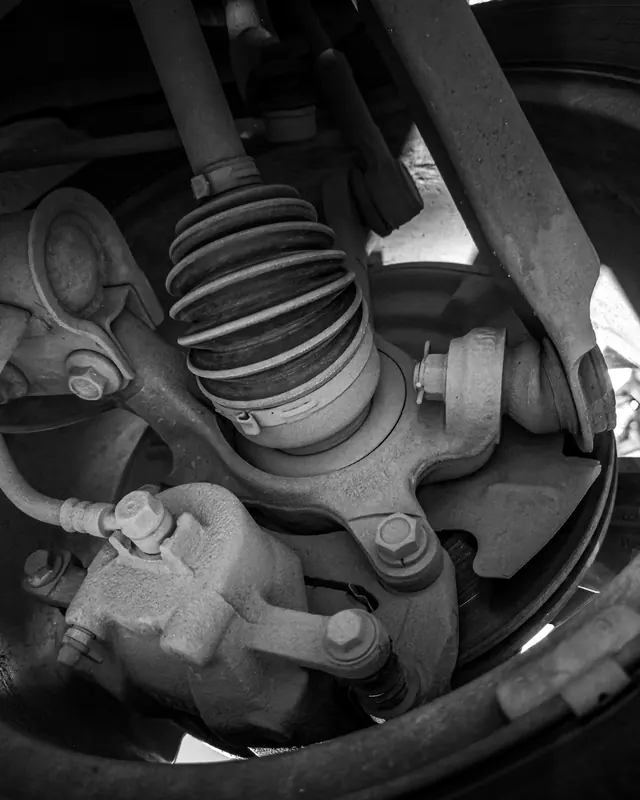
Clicking Noise When Turning? Signs of a Bad CV Axle or Torn Boot
Photo: Zoshua Colah on Unsplash
On this page
The short answer
A clicking or popping noise when you turn, loudest on tight, slow turns like parking lots and U-turns, usually means a worn outer CV joint on one of the front axles. It almost always starts with a torn CV boot that let the grease out and dirt in. The car is drivable for a short while, but a clicking joint is already worn, so have it checked soon rather than waiting for it to get louder.
You pull out of a parking space with the wheel cranked all the way over and hear a click-click-click from the front of the car. Straighten out and it goes away. We hear that one a lot, and it usually points to a worn CV joint on one of the front axles. Here's what that part does, how to spot the early warning sign yourself, and how soon it needs attention.
What is a CV axle?
A CV axle (constant velocity axle, also called a half shaft) carries power from the transmission out to a wheel while the wheel steers and moves up and down with the suspension. Front-wheel-drive cars have one for each front wheel, and many all-wheel-drive cars have them at the back too.
Each axle has two flexible joints. The outer joint sits right behind the wheel and lets it turn left and right. The inner joint sits near the transmission and lets the axle get slightly longer and shorter as the suspension moves. Each joint is packed with grease and covered by a ribbed rubber boot held on with clamps.
Why does my car click when I turn?
The most common cause is a worn outer CV joint. Samarins calls a clicking or popping noise when turning the most common symptom of a worn outer joint, and notes that it gets louder when you accelerate in a turn. AA1Car says a popping or clicking noise when turning almost always means the outer joint is worn or damaged.
The noise comes from the balls and grooves inside the joint, which wear loose once the grease is gone. The sharper the turn, the more the joint is bent, and the more that looseness shows up as a click.
Other things can click or pop on a turn, so it's worth knowing the difference:
| What you notice | Likely cause |
|---|---|
| Clicking or popping on tight turns, faster as you speed up | Worn outer CV joint |
| Clunk when you shift into drive or reverse, or when you go from gas to coasting | Worn inner CV joint, or worn engine or transmission mounts |
| Side-to-side shake when you accelerate, which fades when you let off | Worn inner CV joint or engine mounts |
| Vibration that grows steadily with speed, on or off the gas | More often a tire or wheel issue than an axle |
| Creak or groan over bumps or when turning at a standstill | Suspension or steering parts, such as ball joints or strut mounts |
AA1Car points out that a vibration that increases with speed is rarely caused by a CV joint, and that tire imbalance or a bent rim is more likely. If that sounds like your car, our post on why a steering wheel shakes at highway speed covers those causes.
What causes a CV joint to go bad?
Almost always, a torn boot. The joint itself is tough, and Samarins notes it's not uncommon to see cars past 300,000 miles on their original joints, as long as the boots stay intact. The boot is the weak spot. AA1Car says boots can get brittle and crack with age. They can also get cut by road debris or slip at a clamp.
Once the boot opens up, two things happen at once. The spinning axle flings the grease out, and road dirt and water get in. YourMechanic explains that without grease the joint runs dry, and that leads to failure of the bearings inside it.
How fast that happens depends on the damage. AA1Car says a tiny pinhole may take hundreds or even several thousand miles before the joint runs dry, while a major tear will likely fail within a few hundred miles. It also notes that the more turning you do, the faster outer joints wear, which describes a lot of around-town driving.
How can I tell if my CV boot is torn?
Look for grease where it shouldn't be. Grease leaking from a damaged boot is the earliest sign, often well before any noise. The Drive notes you may see grease on the inside of your wheels or tires, and AA1Car adds the nearby suspension parts: struts, control arms, the steering knuckle and tie rods.
What you can check yourself, parked on level ground:
- With the engine running, turn the steering wheel all the way to one side, then shut the engine off, set the parking brake and leave it in park (or in gear for a manual). That swings the front of the tire out and gives you a better view of the outer boot behind the wheel.
- Use a flashlight and look at the rubber boot. You're looking for cracks between the ribs, a split, or a clamp that has slipped or come off.
- Check for dark, heavy grease on the inside of the wheel, the back of the tire, the suspension parts nearby and the plastic fender liner. YourMechanic notes grease is often thrown onto the fender well liner.
- Start the car, turn the wheel the other way, shut it off and check the other side.
Don't crawl under a car that's only held up by a jack. If you can't see well enough from the side, we can look at it on a lift.
Is it safe to drive with a clicking CV axle?
For a short while, generally yes, but treat it as something to schedule soon, not something to live with. A clicking joint is already worn, and AA1Car says it needs to be replaced without much delay. Samarins warns that a badly worn outer joint can come apart while driving, which can be a hazard. A joint that fails completely can also leave the car unable to move.
Stop driving and have the car checked if:
- The clicking turns into a loud clunk, grinding or banging.
- You feel a heavy vibration or shudder, especially when accelerating.
- The car hesitates to move, or you hear the engine rev without the car pulling.
If the noise is new and mild, keep trips short and local, avoid hard acceleration in turns, and skip the long drives up the I-15 or over the Ortega Highway grades until it's been looked at.
Can you replace just the CV boot?
Sometimes. Samarins says that if a damaged boot is caught early, a new boot and fresh grease is usually all that's needed. AA1Car agrees a joint with no noise or looseness can usually be cleaned and repacked, using CV joint grease rather than ordinary chassis grease.
Once the joint clicks, has play in it, or the grease inside feels gritty, the joint is worn and a new boot won't bring it back. At that point replacing the whole axle is the usual repair. AA1Car notes that many shops and do-it-yourselfers find that faster and easier than rebuilding the joint, and YourMechanic says that once dirt is in the joint, the whole axle needs to be replaced.
When to bring it in
Bring it in soon if you hear clicking on turns, see grease around the inside of a front wheel, or feel a new shake when you accelerate. Here's what we check, in order:
- Drive the car or listen on tight turns in both directions to confirm the noise and which side it's on.
- Put it on a lift and inspect both boots on each axle, the clamps, and the joints for play.
- Check the parts that can sound similar: ball joints, tie rod ends, wheel bearings, struts and engine mounts.
- Give you a written estimate before any work starts, and tell you whether a boot is enough or the axle needs to be replaced.
If the noise is more of a hum or rumble that changes with speed, it may be a wheel bearing or the tires instead. Our tire and wheel services cover the tire side, and a diagnostic will sort out which it is. You can also read more about our steering and suspension repair. Our repairs carry a 1-year/12,000-mile warranty.
Recent work like this at our shop
A few recent jobs from our service records. Vehicle, mileage and month only; no customer details.
| Vehicle | Work | Mileage | When |
|---|---|---|---|
| 2010 Mazda 3 | CV axle | 250,149 mi | Mar 2026 |
| 2012 Jeep Patriot | CV axle | 103,102 mi | Oct 2024 |
Common questions
What does a bad CV joint sound like?
A worn outer CV joint usually makes a rhythmic clicking or popping when you turn, and it gets faster as the car speeds up and louder when you accelerate through the turn. It's easiest to hear on tight, slow turns, like pulling out of a parking space with the wheel turned all the way.
Can I drive with a clicking CV axle?
For a short time, usually yes, but don't put it off. Clicking means the joint is already worn, and AA1Car notes that once it starts, the joint needs to be replaced without much delay. A worn joint can eventually fail and leave you stranded, and a joint that gives out while driving can be a hazard.
Is a torn CV boot an emergency?
Not an emergency, but it's worth catching early. A small crack can take a long time to cause damage, while a badly torn boot lets the grease out and dirt and water in, and AA1Car says a joint with a major tear will likely fail within a few hundred miles.
Can you replace just the CV boot?
Sometimes. If the torn boot is caught early and the joint is still quiet and tight, a new boot with fresh CV grease can be enough. Once the joint clicks, has play or the grease feels gritty, the joint is worn, and replacing the whole axle is usually the practical repair.
Why does it only click when I turn one way?
Each front wheel has its own axle, and the outer joint works hardest when its wheel is turned sharply. A noise that shows up turning only one direction usually points to one side's joint, and checking both boots for grease usually tells you which one.
Sources
More from the blog
BMW Water Pump Recall: Which Models Should Park Outside and What to Do
NHTSA told owners of 720,796 BMWs to park outside over a water pump connector fire risk. Which models are covered, what to do now and when you can check your VIN.
Exhaust Leak Symptoms: Ticking, Loud Exhaust and Fumes in the Car
A ticking at startup, a louder exhaust or fumes inside the car? The common signs of an exhaust leak, why fumes in the cabin matter and when to have it checked.
Does Going to an Independent Mechanic Void Your Car's Warranty?
What the FTC says about servicing a car under warranty at an independent shop, which records to keep, and why recalls and covered repairs still go to the dealer.