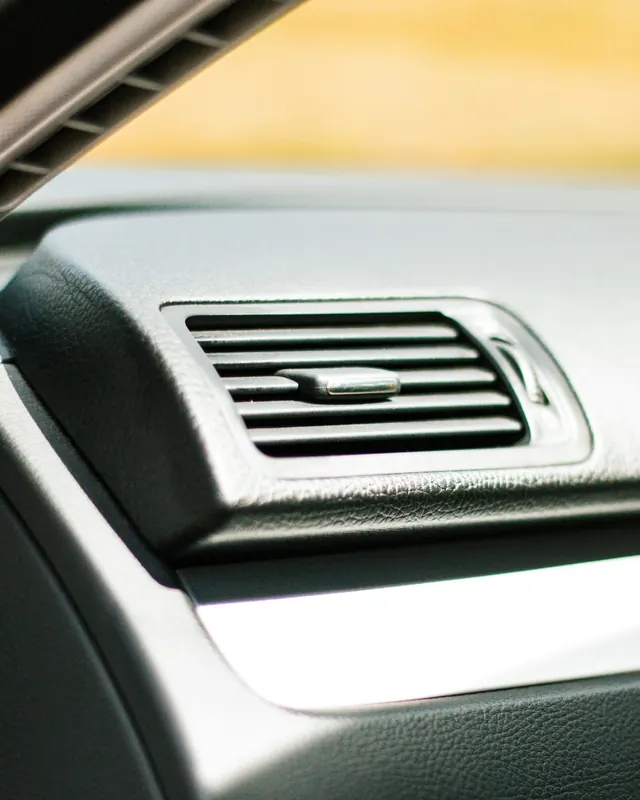
Wildfire Smoke and Your Car: Recirculate Mode and the Cabin Air Filter
Photo: Jordan Catto on Unsplash
On this page
- The short answer
- How do you keep wildfire smoke out of your car?
- What does a cabin air filter do?
- How often should you change the cabin air filter?
- What are the signs of a clogged cabin air filter?
- Is the cabin air filter the same as the engine air filter?
- When to bring it in
- Recent work like this
- Common questions
The short answer
When there's smoke in the air, close the windows and run the A/C on recirculate, which is what the EPA recommends for vehicles. The cabin air filter catches dust, ash and pollen before outside air reaches your vents, but a standard filter may not stop fine smoke particles, so recirculate matters most. Most cars call for a new filter every 12,000 to 15,000 miles or once a year, and sooner after heavy smoke or dust.
When the Santa Ana winds kick up and there's a fire somewhere upwind, you can smell it in the car before you see the haze. Here's how to keep as much of that smoke and dust out of the cabin as you can, what the cabin air filter actually does, and when it's time for a new one.
How do you keep wildfire smoke out of your car?
Close the windows and run the A/C on recirculate. That's the EPA's advice for vehicles. Recirculate reuses the air already inside the car instead of pulling outside air through the vents, so less smoke comes in.
A few more steps that help on a smoky day:
- Close everything. Windows, sunroof, and any rear vents you can shut.
- Press recirculate before you start driving, not after the cabin already smells. On most cars it's the button with an arrow curving around inside a car outline.
- Keep the fan and A/C on so the air inside keeps circulating.
- Slow down when visibility drops. The EPA also says to slow down when smoke limits how far you can see. Turning your headlights on helps other drivers see you.
- Check the air before you go. The AirNow Fire and Smoke Map, run by the EPA and the U.S. Forest Service, shows current particle pollution, fire locations and smoke plumes near you.
If the windows start to fog while you're on recirculate, switch to defrost for a minute to clear the glass, then go back to recirculate. On many cars, defrost brings in outside air on its own, so expect a whiff of smoke while it runs.
What does a cabin air filter do?
It cleans the outside air before it comes out of your vents. The Car Care Council says it traps pollen, bacteria, dust and exhaust gases that would otherwise get into the heating and A/C system. In smoke and wind season it's also catching ash and the dust that blows around when the Santa Anas come through. AAA notes that a standard cabin filter may not capture very fine particles like smoke, which is why recirculate matters most. The filter still clogs faster when the air is dirty.
Most newer cars have one; your owner's manual will say. On many cars it sits behind the glove box or under the dashboard. Some filters have an activated charcoal layer that AAA says helps with odors. Your manual or the parts catalog for your car will show which types fit.
The filter only helps if air can get through it. A clogged one restricts airflow, so the fan works harder and you get less air for the same setting.
How often should you change the cabin air filter?
Start with your owner's manual. AAA says most vehicles need a new cabin filter every 12,000 to 15,000 miles or once a year. The Car Care Council gives the same mileage and adds that it should be replaced more often where there's heavy smoke, debris or other contaminants in the air. It also says a dirty filter shouldn't be cleaned and reinstalled. Replace it.
Around Lake Elsinore, Wildomar and Menifee, a lot of driving fits that "more often" description: dirt roads and construction dust, dry Santa Ana winds most falls, and smoke from fires in the hills some years. If your last filter went in before summer, the end of a windy, smoky stretch is a sensible time to look at it.
What are the signs of a clogged cabin air filter?
AAA lists these signs. Here's what each one looks like from the driver's seat:
| Sign | What you notice |
|---|---|
| Weak airflow | The fan is on high but not much air comes out |
| Musty or stale smell | An odor coming from the vents |
| Slow defogging | The windshield takes longer to clear |
| Uneven heating or cooling | The cabin never quite gets comfortable |
| More dust inside | A film on the dash soon after you wipe it |
Weak airflow can also come from other A/C or blower problems, so a clean filter is a good first check, not the whole answer. If your A/C is blowing warm rather than just weak, our post on why your car A/C is blowing warm air covers the usual causes.
Is the cabin air filter the same as the engine air filter?
No, and they're easy to mix up. AAA explains the difference: the engine air filter supplies clean air for the engine to burn with fuel, while the cabin air filter cleans the air you breathe inside the car. They sit in different places (the engine filter is in a box under the hood) and each has its own interval in the owner's manual.
Dusty, smoky air is hard on both, so check each one against its interval in the manual. If you're in for an oil change, ask us to look at the cabin filter while the car is here. Our guide on how often to change your oil explains why dusty driving often counts as "severe service" in the manual.
When to bring it in
Bring the car in if the airflow from the vents is weak even on high, if the cabin smells musty or like smoke days after the air outside has cleared, if the windows are slow to defog, or if you can't remember when the cabin filter was last changed.
Here's what we'd check, in order:
- The cabin air filter itself: how loaded it is, and whether it's the right type for your car.
- Blower and airflow at each setting, and that recirculate and the vent doors switch the way they should.
- If the A/C isn't cooling well, the A/C system itself, starting with a diagnostic check.
You get a written estimate before we do any work, and repairs come with our 1-year/12,000-mile warranty. See all our services or call (951) 445-8055.
Recent work like this at our shop
A few recent jobs from our service records. Vehicle, mileage and month only; no customer details.
| Vehicle | Work | Mileage | When |
|---|---|---|---|
| 2022 Mercedes-Benz GLE350 | Cabin air filter | 50,499 mi | Oct 2025 |
| 2017 Ford Edge | Cabin air filter | 99,573 mi | Aug 2024 |
| 2015 Honda Accord | Cabin air filter | 241,127 mi | Jun 2023 |
| 2017 Ford Edge | Cabin air filter | 60,018 mi | Mar 2023 |
| 2010 Ford Edge | Cabin air filter | 250,204 mi | Feb 2023 |
Common questions
Does recirculate keep smoke out of my car?
Yes, it helps. The EPA says to reduce smoke in your vehicle by closing the windows and running the air conditioner in recirculate mode. Recirculate reuses the air already inside the car instead of pulling in smoky outside air, so less smoke gets in.
How often should I change my cabin air filter?
Check your owner's manual first. AAA says most vehicles need one every 12,000 to 15,000 miles or once a year, and the Car Care Council says to replace it more often where there's heavy smoke or debris in the air. A filter that's clogged should be replaced, not cleaned and put back.
Is the cabin air filter the same as the engine air filter?
No. The engine air filter cleans the air the engine burns with fuel. The cabin air filter cleans the air that comes out of your vents for the people inside. They're different parts in different places, and each has its own interval in the owner's manual.
Where is the cabin air filter?
On many cars it's behind the glove box or under the dashboard, according to AAA. Your owner's manual shows where it is and whether it's an easy reach or a job for the shop.
Why does my car still smell like smoke after the fire is out?
Smoke odor can linger in the cabin filter and in the seats, carpet and headliner. A new cabin filter is a good first step. If the vents still smell musty after that, have the A/C system looked at.
Sources
- U.S. Environmental Protection Agency, Reduce Your Smoke Exposure
- AAA, Keeping Your Cabin Air Filter Clean
- Car Care Council, As Fires Continue to Burn, Changing Cabin Air Filter a Must
- AirNow (EPA and U.S. Forest Service), About the Fire and Smoke Map
- California Governor's Office of Emergency Services, Santa Ana Winds Bring Increased Fire Risk
More from the blog
Driving in the First Rain: Why the Roads Get So Slick and What to Do
Why the first rain after a dry summer makes roads so slippery, how to drive it, what to do if you hydroplane, and the tire and wiper checks worth doing first.
Getting Your Car Ready for a Southern California Winter
Winter here means rain, cold mornings and trips to the snow. What to check on your battery, tires, wipers and coolant, plus Caltrans chain rules for Big Bear.
Why Are My Headlights Foggy, and How Do You Fix Them?
What turns plastic headlights cloudy and yellow, how much light you lose, whether restoration kits work, and when a new headlight is the better answer.