Tire Pressure Light On When It's Cold? Why It Happens and What to Do
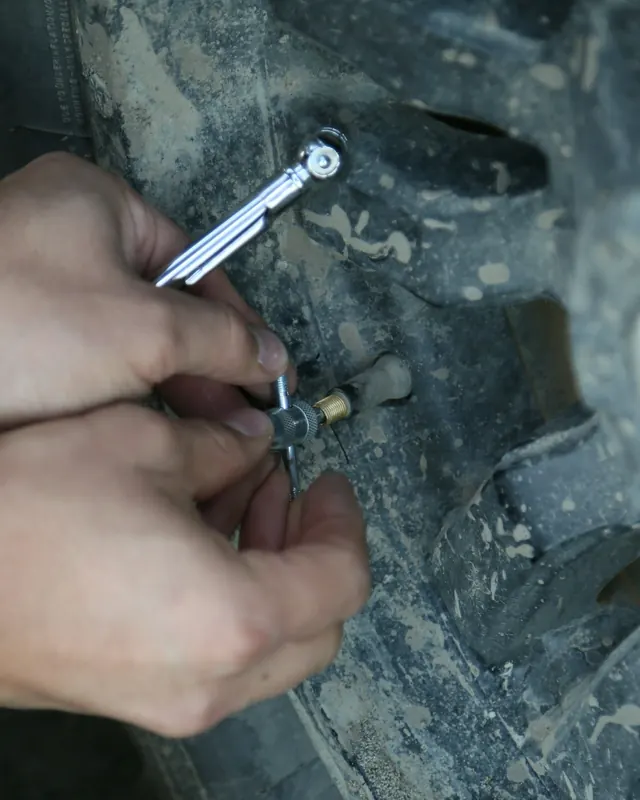
Photo: Brendan Hollis on Unsplash
On this page
The short answer
Air pressure drops about 1 psi for every 10°F the temperature falls, so a tire that was already a little low can trip the light on the first cold morning. A light that stays solid means at least one tire is low: check all four with a gauge and fill them to the door sticker pressure. A light that flashes for about a minute and then stays on points to a problem with the monitoring system itself.
You walk out on the first chilly morning of the season, start the car, and there's a little yellow horseshoe with an exclamation point on the dash. Ten minutes down the road it might even go off by itself. It's a common one this time of year, and it's usually simple to deal with. Here's why it happens, what to do, and how to tell cold weather from a real leak.
Why does the tire pressure light come on when it's cold?
Air shrinks as it cools. AAA Club Alliance puts the drop at about 1 psi for every 10°F, and the pressure comes back up about as much when it warms. Fall is when drivers here start to notice this: the tires were last set in the heat, and then the mornings turn cold.
Here's what that looks like on a car with a 35 psi door sticker. A tire set to 35 psi on a 95°F day in September would read around 30 psi on a 45°F morning. That's low, but it won't trip the light by itself. Continental says the warning comes on at about 25% below the recommended pressure, or around 26 psi for that same tire.
So the light usually means the tire was already a few psi down before the weather turned. Tires slowly lose a little air over time, and the cold morning is just what finally pushes one past the line.
Why did the light go off after I started driving?
Because the tires warmed up. Rolling heats a tire, and the air inside it, so the pressure climbs back over the warning line. AAA Club Alliance notes that this increase is temporary.
The tire didn't fix itself. The light will probably be back tomorrow morning, and you've been driving on a low tire in between. Treat that first warning as your reminder to check them.
Solid or flashing: what's the difference?
Here's what the light usually means, based on what it does.
| What the light does | What it usually means | What to do |
|---|---|---|
| Comes on and stays solid | At least one tire is well below the recommended pressure | Check all four with a gauge and fill them |
| Comes on cold, goes off once you've driven | A tire is low, right around the warning line | Check them the next morning before you drive |
| Comes back within days of filling | Likely a slow leak in that tire | Have the tire looked at |
| Flashes 60 to 90 seconds, then stays solid | A fault in the monitoring system, not just low air | Check pressure by hand and have the system looked at |
The flashing version has a common cause on older cars. Most systems use a sensor inside each wheel, and Continental says those sensors have non-replaceable batteries that last about 5 to 10 years. When one dies, the light can't be cleared by adding air.
How do I fix it the right way?
You can do this yourself with a gauge and an air pump.
- Check when the tires are cold. NHTSA defines that as not driven for at least three hours. First thing in the morning is ideal.
- Find the right number. It's on the label on the driver's door edge or in your owner's manual. Don't use the number on the tire's sidewall. AAA Club Alliance says that's the tire's maximum, not the target.
- Check all four with a gauge, plus the spare if you have one. A compact spare usually takes a higher pressure, so check the number on the spare or in your owner's manual. NHTSA notes that an underinflated tire is hard to spot by eye. The dash light itself won't tell you how low a tire is, and on many cars it won't tell you which one.
- Add air to the sticker number. If the nearest pump is a short drive away, the tires may read slightly high from the trip, so recheck the next morning.
- Give the light a chance to clear. It can take 10 to 15 minutes of steady driving to go off, and some cars need a reset procedure, which will be in your owner's manual.
Don't set your tires high to get ahead of the cold. AAA Club Alliance warns that overinflated tires wear the center of the tread faster and give you a harsher ride with less control.
How do I know if it's a leak and not just the cold?
Cold weather affects all four tires about equally, and once filled they should hold for weeks. A leak behaves differently.
It's probably a leak if:
- One tire keeps reading lower than the others.
- The light comes back within days or a couple of weeks of filling.
- You find a nail or screw in the tread, or hear a hiss around the valve stem. Leave a nail in and bring the car in, since pulling it can let the air out quickly.
Common sources are a puncture in the tread, a worn valve stem, or a poor seal where the tire meets the wheel. Don't put it off because the leak is slow. The U.S. Tire Manufacturers Association says underinflated tires build up excess heat and stress, which causes irregular wear and internal damage. That matters on a long I-15 run or on a loaded trip up to Big Bear, where it's colder still and the light can come on while you're there. Our tire safety checklist covers tread and tire age if you're looking everything over anyway.
The light is only a backstop. The U.S. Tire Manufacturers Association says these systems don't replace a monthly check with a gauge, and that on many vehicles the warning may come too late to prevent damage. If other lights are on too, our guide to dashboard warning lights explains which ones can wait.
When to bring it in
Bring it in if one tire keeps losing air, if the light flashes at startup, or if the light stays on after you've filled all four tires to the sticker pressure. Stop and get the car looked at before driving further if a tire looks visibly low, or you feel a thump, a pull or a new vibration.
Here's what we do, in order:
- Check all four tires against the door sticker, and check the spare.
- Look over each tire and valve stem for nails, damage and leaks.
- If the light is flashing, run a diagnostic and tell you what we find and what the next step is.
- Give you a written estimate before any work starts. Our repairs carry a 1-year/12,000-mile warranty.
You can read more about our tire and wheel service or book a diagnostic if you're not sure what the light is telling you.
Recent work like this at our shop
A few recent jobs from our service records. Vehicle, mileage and month only; no customer details.
| Vehicle | Work | Mileage | When |
|---|---|---|---|
| 2015 Ford F-150 | Tire rotation | 80,684 mi | Jul 2026 |
| 2014 Toyota Camry | Tire rotation | 125,143 mi | Apr 2026 |
| 2010 Mazda 3 | Tire rotation | 250,149 mi | Mar 2026 |
| 2016 Toyota Camry | Tire rotation | 192,017 mi | Feb 2026 |
| 2019 Toyota Tacoma | Tire rotation | 132,105 mi | Feb 2026 |
Common questions
Why did my tire pressure light go off after I drove a few miles?
Driving warms the tires, and warm air raises the pressure. AAA Club Alliance says this increase is temporary, so the light going off doesn't mean the tire is fine. Check the pressure with a gauge the next morning before you drive and add air if it's below the door sticker number.
Is it safe to drive with the tire pressure light on?
If the tires look normal and the car handles normally, you can drive slowly to the nearest air pump and check them. Continental says to keep that under 5 miles at low speed, and to check and fill within 24 hours, or right away if a tire looks visibly low or the handling feels off. Don't keep driving on it for days, and pull over if you feel a thump, a pull or a vibration.
What should my tire pressure be in cold weather?
Use the same number all year: the one on the sticker on the driver's door or in your owner's manual, measured when the tires are cold. NHTSA says the right pressure is what the vehicle manufacturer lists, not what's on the tire. The number on the tire's sidewall is its maximum, not a target.
Should I let air out when the tires warm up in the afternoon?
No. It's normal for a warm tire to read above the sticker number, and that extra pressure goes away when the tire cools. If you bleed it down while it's warm, it will be low by the next morning. Only adjust pressure when the tires are cold.
Why does the light flash when I start the car?
A light that flashes for 60 to 90 seconds and then stays solid means the monitoring system has a fault, according to Continental. A sensor with a dead battery is a common cause. While it's doing this it may not warn you about a low tire, so check your tires with a gauge until it's looked at.
Sources
More from the blog
Why Does My Car Pull to One Side? Causes and What to Check
Car drifts right or left when you let go of the wheel? The usual causes, from tire pressure to alignment and a sticking brake, and what to check yourself.
Why Does My Steering Wheel Shake at Highway Speed?
Steering wheel shakes on the freeway but smooths out when you slow down? The usual causes, what you can check yourself and when it's not safe to drive.
A Mechanic's Tire Safety Checklist (Pressure, Tread and Age)
How to check tire pressure the right way, read tread depth with a penny, find your tire's age on the sidewall, and know when tires are due for replacement.